

Vendor Ticketing System for Faster Supplier Issue Resolution
Vendora vendor ticketing system helps procurement, vendor management, quality, finance, stores, and supplier teams log, assign, track, resolve, and document vendor-related issues in one structured workflow.
Replace scattered emails, phone calls, WhatsApp messages, and manual follow-ups with a digital ticket management system that gives buyers and vendors shared visibility into issue status, ownership, response history, and resolution progress.
Issue Logging
Capture vendor issues, incidents, complaints, missed deadlines, document gaps, quality problems, and payment queries.
Ticket Assignment
Assign tickets to procurement, vendor managers, finance users, quality teams, or responsible internal owners.
Status Tracking
Track open, assigned, in-progress, pending vendor, escalated, resolved, and closed ticket status.
Resolution History
Maintain issue history, communication thread, documents, resolution notes, and recommendations for future reference.
Why Companies Need Vendor Ticketing Software
Vendor issue management becomes difficult when supplier complaints, quality issues, invoice queries, payment follow-ups, delivery delays, document gaps, and clarification requests are handled through emails, calls, and disconnected communication channels.
Scattered Vendor Communication
Buyers and vendors often discuss issues across email threads, calls, and messages, making it difficult to know the latest status or responsible owner.
Unclear Issue Ownership
Vendor issues may move between procurement, finance, quality, stores, and admin teams without clear assignment, escalation, or closure responsibility.
Weak Resolution History
Without a ticketing workflow, teams struggle to review past issues, repeated vendor problems, resolution notes, and corrective recommendations.
Vendora Turns Vendor Issues Into a Trackable Workflow
Vendora helps teams identify vendor issues, create tickets, assign owners, track progress, communicate in a shared thread, resolve problems, and document the final outcome.
Vendora Ticketing Dashboard Preview
A buyer-side ticketing view for tracking vendor issues, ticket ownership, priority, status, communication history, pending actions, escalation, and closure.
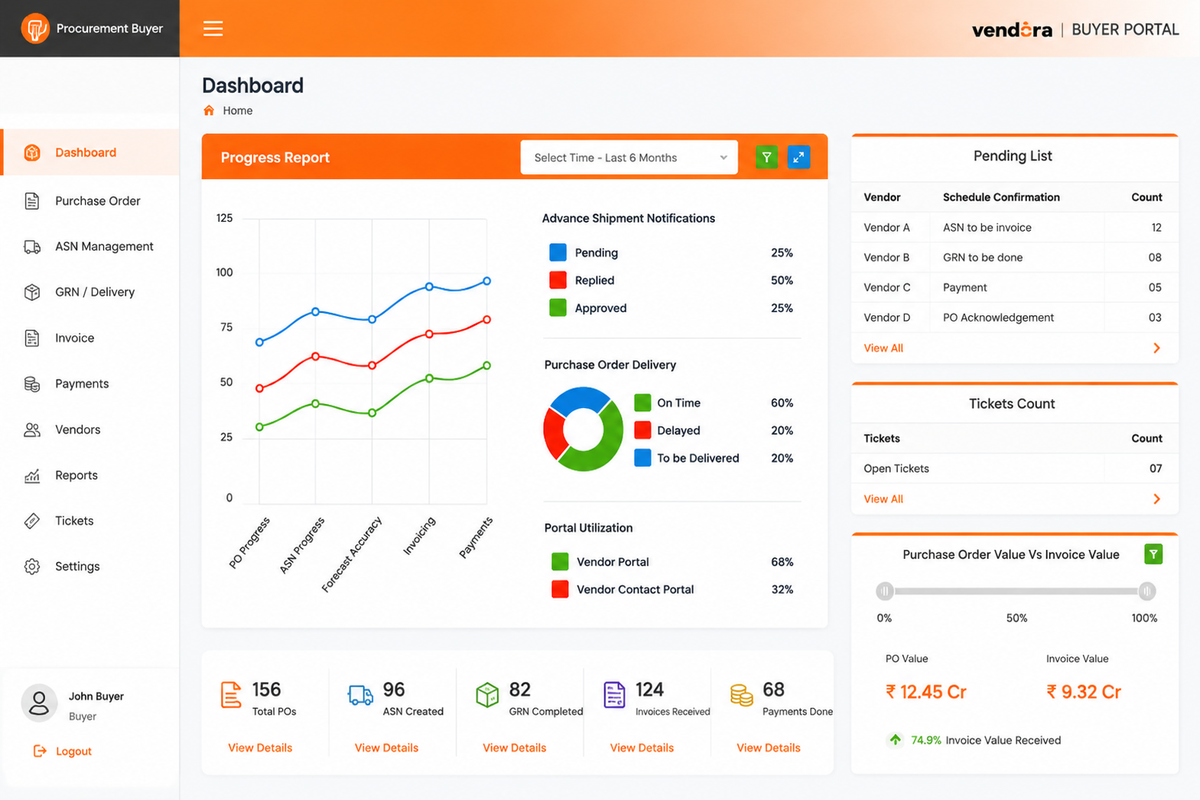
Example vendor ticketing dashboard view for monitoring open issues, assigned owners, vendor responses, resolution progress, and closure status.
Core Capabilities of Vendora Vendor Ticketing System
Vendora helps procurement, finance, quality, stores, and vendor teams manage supplier issues with better visibility, accountability, and response control.
Vendor Issue Identification
Identify and log vendor-related issues such as missed deadlines, quality problems, document gaps, invoice questions, payment queries, or delivery exceptions.
- Vendor issue category
- Incident description
- Priority level
- Supporting documents
Ticket Creation
Create a ticket with vendor name, issue type, description, attachments, responsible department, and expected resolution timeline.
- Ticket number
- Vendor reference
- Issue details
- Document upload
Ticket Assignment
Assign tickets to the right internal owner such as vendor manager, procurement specialist, finance user, quality user, stores user, or admin team.
- Owner assignment
- Department routing
- Priority handling
- Escalation owner
Ticket Status Tracking
Track each ticket from creation to resolution with clear status visibility for buyers, vendors, and internal stakeholders.
- Open status
- In-progress status
- Pending vendor status
- Resolved or closed status
Shared Communication Thread
Consolidate buyer-vendor communication inside one ticket thread to reduce confusion and avoid scattered follow-ups.
- Buyer comments
- Vendor responses
- Internal remarks
- Communication history
Ticket Resolution
Document resolution details, lessons learned, corrective actions, closure remarks, and recommendations to avoid repeat issues.
- Resolution notes
- Closure remarks
- Corrective action
- Future prevention steps
SLA and Response Tracking
Track response time, resolution time, pending age, escalation delay, and service standard compliance.
- Response time
- Resolution time
- SLA status
- Escalation alerts
Vendor Issue Reports
Analyze ticket volume, repeated vendor issues, unresolved tickets, department-wise delays, and issue categories.
- Open ticket report
- Issue category report
- Vendor-wise ticket report
- Resolution aging report
Vendor Performance Insights
Use ticketing data to understand vendor responsiveness, recurring issues, service gaps, and supplier relationship risks.
- Vendor issue history
- Repeat issue tracking
- Response quality
- Supplier scorecard input
Buyer, Vendor, and Internal Team Actions
Vendora gives each stakeholder clear ownership across issue reporting, assignment, communication, resolution, and closure.
| Workflow Step | Buyer / Procurement Action | Vendor Action | Internal Team Action | Business Value |
|---|---|---|---|---|
| Issue Identification | Logs a vendor issue related to delivery, quality, invoice, payment, document, or service. | Raises or responds to issue details where configured. | Reviews issue type and required department involvement. | Creates a single source of truth for vendor problems. |
| Ticket Creation | Creates ticket with priority, category, vendor name, description, and attachments. | Receives ticket visibility or clarification request. | Receives assigned ticket based on issue category. | Standardizes issue logging and communication. |
| Ticket Assignment | Assigns or routes the ticket to the right owner. | Waits for response or adds required information. | Accepts ownership and starts investigation. | Improves accountability and reduces unresolved issues. |
| Tracking and Communication | Monitors status, response, and escalation requirements. | Responds with clarification, documents, or corrective action. | Updates progress, remarks, and next action. | Improves visibility and reduces repeated follow-ups. |
| Resolution and Closure | Reviews resolution and closes the ticket. | Confirms resolution or provides final response. | Documents closure remarks and recommendations. | Creates a reusable issue history for future reference. |
Vendor Ticketing Before and After Vendora
Vendora helps companies move from scattered vendor issue handling to structured, accountable, and documented ticket management.
| Ticketing Area | Before Vendora | With Vendora Vendor Ticketing |
|---|---|---|
| Issue Logging | Vendor issues are reported through emails, phone calls, WhatsApp messages, or informal notes. | Issues are logged as structured tickets with category, priority, owner, and attachments. |
| Ownership | It is unclear whether procurement, finance, quality, stores, or admin owns the issue. | Tickets can be assigned to the right team member or department with clear ownership. |
| Communication | Buyer-vendor conversations are scattered across channels and difficult to trace. | Communication can be consolidated inside one ticket thread with shared visibility. |
| Status Tracking | Teams manually follow up to know whether the issue is open, pending, escalated, or resolved. | Status can be tracked across open, assigned, in-progress, pending, resolved, and closed stages. |
| Resolution History | Past issues, root causes, and lessons learned are difficult to review. | Resolution notes, recommendations, and issue history are documented for future reference. |
| Reporting | Repeated vendor issues and team response delays are hard to measure. | Reports can show ticket volume, response time, resolution time, issue categories, and vendor trends. |
Why Vendor Ticketing Matters in Supplier Management
A structured ticketing system helps companies improve issue visibility, response time, supplier accountability, service standards, and relationship quality.
Faster Response Time
Assign tickets quickly and track whether owners are responding within expected timelines.
Improved Productivity
Reduce manual follow-ups by centralizing issue communication and next-action tracking.
Better Vendor Relationships
Give vendors a transparent issue resolution process instead of uncertain email follow-ups.
Service Standard Control
Track response, resolution, escalation, and SLA performance for vendor-related issues.
Operational Insights
Identify repeated issue categories, process gaps, supplier delays, and team bottlenecks.
Audit-Ready Documentation
Maintain ticket history, attachments, communication, resolution notes, and closure records.
Who Uses Vendora Vendor Ticketing System?
Vendora supports teams involved in vendor communication, issue resolution, procurement execution, finance queries, quality issues, and supplier performance management.
Procurement Teams
Log vendor issues, assign owners, track status, monitor supplier responses, and close procurement-related tickets.
Vendor Managers
Manage vendor communication, monitor repeated supplier issues, review ticket history, and improve relationship quality.
Vendors and Suppliers
Respond to tickets, upload documents, clarify issues, share corrective actions, and track resolution status.
Finance Teams
Handle invoice queries, payment queries, missing document issues, and payment-related vendor tickets.
Quality Teams
Manage defect-related tickets, quality clarifications, rejected quantity issues, and corrective action responses.
Management Teams
Monitor unresolved tickets, vendor issue trends, escalation volume, service standards, and operational bottlenecks.
Vendor Ticketing KPIs to Track
Vendora helps teams measure issue resolution efficiency, supplier responsiveness, internal accountability, SLA performance, and vendor relationship health.
Open Tickets
Number of vendor issues currently open, assigned, pending, or escalated.
Response Time
Time taken by internal owners or vendors to respond to a ticket.
Resolution Time
Time taken from ticket creation to final resolution and closure.
SLA Compliance
Tickets resolved within agreed service standards or expected response timelines.
Escalation Rate
Tickets escalated due to delay, non-response, repeated issue, or unresolved ownership.
Repeat Issues
Recurring vendor issues by category, supplier, department, or workflow stage.
Vendor Response Quality
Vendor response completeness, turnaround time, and corrective action quality.
Closure Rate
Tickets resolved and closed compared to total tickets raised in a period.
Vendor Ticketing as Part of a Connected Procurement Workflow
Vendora vendor ticketing can support issues across vendor onboarding, RFQ, purchase order, ASN, GRN, quality inspection, invoice management, payment tracking, vendor reports, and supplier relationship management.
This helps procurement-driven organizations maintain a structured record of vendor issues, reduce manual communication, improve service standards, and make vendor performance reviews more data-driven.
Related Vendora Product Pages
Use these internal links to connect vendor ticketing with the wider procurement and vendor management lifecycle.
Vendor Ticketing System FAQs
What is a vendor ticketing system?
A vendor ticketing system helps companies log, assign, track, resolve, and document vendor-related issues such as delivery delays, invoice queries, payment questions, quality problems, and document gaps.
How does Vendora help with vendor issue management?
Vendora helps teams create tickets, assign owners, track ticket progress, consolidate buyer-vendor communication, document resolution, and analyze repeated vendor issues.
Can buyers and vendors communicate inside the ticket?
Yes. Vendora can consolidate related communication in a shared ticket thread so buyers and vendors have better visibility into the issue and resolution progress.
Who can be assigned to a vendor ticket?
A vendor ticket can be assigned to a vendor manager, procurement specialist, finance user, quality user, stores user, admin user, or another responsible internal team member.
Can Vendora track ticket resolution status?
Yes. Vendora can help teams track whether a ticket is open, assigned, in progress, pending vendor response, escalated, resolved, or closed.
Does vendor ticketing improve supplier relationships?
Yes. A structured ticketing workflow improves transparency, response time, issue ownership, documentation, and vendor communication quality.
Can vendor ticketing support SLA tracking?
Yes. Vendor ticketing can help track response time, resolution time, escalation, pending age, and service standard compliance.
How can we evaluate Vendora vendor ticketing system?
Book a product demo and share your vendor count, issue categories, departments involved, escalation rules, SLA expectations, ERP system, and current vendor communication challenges.
Ready to Streamline Vendor Issue Resolution?
Book a Vendora demo to see how issue logging, ticket assignment, buyer-vendor communication, status tracking, escalation, resolution history, reporting, and supplier performance insights can work for your procurement process.
Book Product Demo Request Quote
![A modern smartphone showing the [Vendor Portal Management System] dashboard for on-the-go vendor collaboration.](https://www.vendorascmsoftware.com/wp-content/themes/vendora/images/phone.webp)
