

Introduction
Getting transportation services isn’t usually just about picking one vendor for one thing.
A manufacturing company might need transportation for different places, routes, delivery times, vehicle types, carrying capacities, and service expectations, all at once. When this process is handled through emails and spreadsheets, even a simple request for quote (RFQ) can become hard to manage.
In this case study, the customer is a manufacturing company that handles a lot of transport-related work. They source logistics vendors and manage RFQs for multiple needs. The procurement team had already noticed that doing this manually led to extra work, difficult quote comparisons, and poor visibility into the sourcing process.
Their goal wasn’t just to create RFQs faster. The real need was to manage complex transport RFQs in a clear and organized way. They wanted the procurement team to see what was requested, which vendors were involved, what each vendor offered, and how the final decision was made.
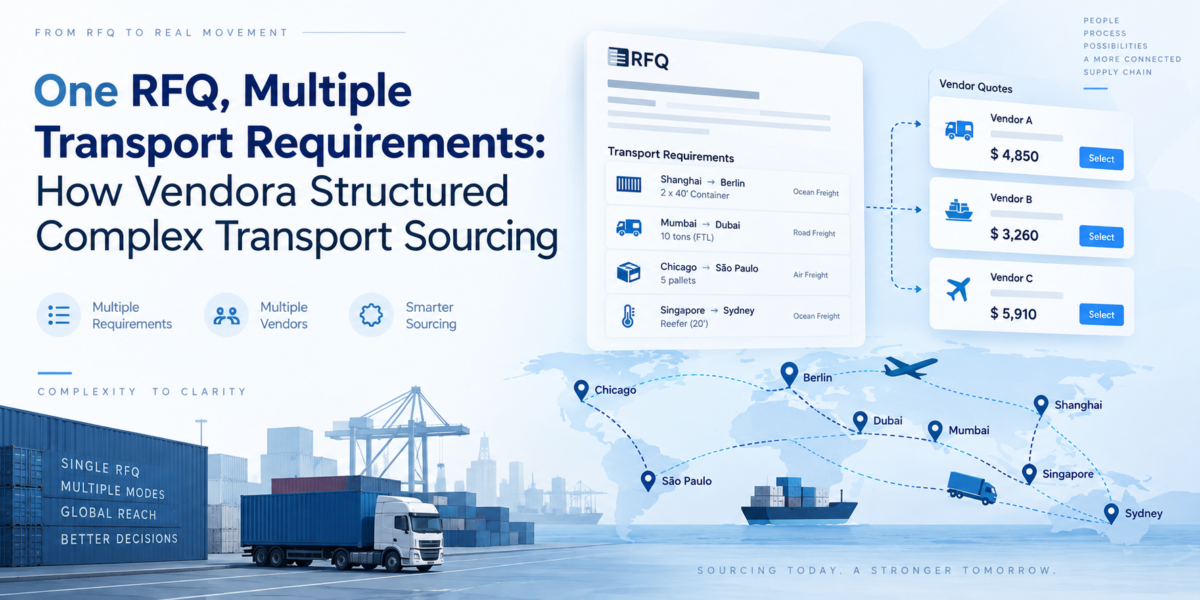
To meet this need, they implemented Vendora, which helps manage RFQs for multiple transport needs, different line items, and multiple vendor responses.
About the Customer
The customer is a manufacturing company that handles a lot of transport activity and has ongoing needs for transporting goods.
Their environment includes:
- Multiple transport needs across different routes, locations, and delivery requirements
- Procurement involving several logistics and transport vendors, with RFQs that include more than one service or line item
- Comparison of vendor quotes based on different cost and operational factors, with stakeholders from procurement, supply chain, logistics, finance, operations, plant procurement, and IT
- A need for better visibility into how sourcing decisions were made and which vendors participated
The main users of this process were the Head of Procurement, Procurement Manager, Purchase Manager, Supply Chain Head, Logistics Head, Transport Manager, and Commercial Manager. Secondary users included finance, operations, plant procurement teams, and IT or digital transformation teams.
The customer wasn’t just realizing there was a problem. They had already seen the inefficiencies of using emails and spreadsheets for RFQs. They were looking for procurement software that could help handle complex sourcing situations.
The Business Challenge
The procurement team wasn’t struggling because they didn’t have an RFQ process. The problem was that the process wasn’t organized enough for the complexity of transport sourcing.
A single sourcing event could involve:
- Different transport routes
- Different starting and ending locations for goods
- Multiple vehicle types
- Special rates for certain routes
- Different load or capacity needs
- Separate delivery times
- Multiple vendors responding to different parts of the request
- Changed quotes after discussions with vendors
- Management decision-making before finalizing a vendor
When this was done manually, the team faced several issues.
Handling Related Requirements Separately
Transport needs that were related were often treated as separate RFQs. This led to repeated work and made it hard to manage everything under one sourcing event.
For example, if a team needed vehicles for different routes or varying capacities, buyers had to manage separate communication threads or separate sections in spreadsheets for each need.
Manually Consolidating Quotations
Vendor quotes often came in different emails, attachments, or formats. Procurement teams had to combine these manually into spreadsheets.
This took unnecessary time and increased the chance of missing a vendor’s response, copying data incorrectly, or comparing the wrong version of a quote.
Comparing Line Items Was Hard
Transport RFQs often needed comparisons at the line-item level. One vendor might be suitable for one route but not another. Another might offer better delivery times but less competitive pricing.
Without a structured RFQ process, buyers had to manually compare vendor responses across different rows, files, and email threads.
Limited Visibility into Vendor Participation
Management wanted to know which vendors were invited, which vendors responded, which quotes were still pending, and why a particular vendor was chosen.
With manual processes, it was hard to clearly show the sourcing process and explain vendor selection.
Weak Auditing of Sourcing Decisions
RFQ history and decision records were scattered. If a stakeholder later asked how a vendor was chosen, procurement had to piece together the story from emails, spreadsheet versions, and notes.
This made the sourcing process seem less transparent and reduced confidence in its fairness and accuracy.
Previous Process vs New Process
| Before Implementation | After Implementation |
| Separate RFQs were made for each transport need | Multiple transport needs could be grouped in one RFQ |
| Vendor quotes came in by email, attachments, and other formats | Vendor responses were tied to the RFQ |
| Line items were compared by hand in spreadsheets | Buyers could check responses against the RFQ requirements |
| Procurement teams had to follow up with vendors often | It was easier to track and manage pending vendor responses |
| Multiple versions of quotes caused confusion | RFQ responses and changes were easier to track |
| Management had limited visibility into sourcing progress | RFQ progress, vendor involvement, and decisions were clearer |
| Sourcing records were hard to check later | RFQ history and vendor selection reasons were better organized |
| Using spreadsheets slowed down the sourcing process | There was less reliance on spreadsheets for RFQ management |
The Solution Implementation
Vendora was picked because the team needed more than just a way to collect quotes.
The procurement team needed a system that could handle complex RFQs, allow multiple vendors to respond, track responses in the right context, and connect sourcing decisions with other procurement tasks.
The focus was on the RFQ feature and how it could improve visibility in procurement.
1. Grouping Multiple Transport Needs in One RFQ
Instead of making separate RFQs for each transport route or need, the process was set up to combine related needs into one RFQ.
This helped keep sourcing organized and prevented the team from creating too many separate RFQs.
2. Adding Multiple Line Items
The RFQ format allowed buyers to create several line items or transport needs in one request.
Each line item could cover a specific route, capacity, schedule, location, or service. This made it easier for vendors to respond properly and for buyers to compare quotes in a clear way.
3. Inviting Multiple Vendors
The same RFQ could be shared with several selected transport vendors.
This allowed for a competitive process without having to manage multiple communications separately.
4. Keeping Vendor Responses Connected
Instead of being scattered across emails and spreadsheets, vendor quotes stayed linked to the RFQ.
This made it easier to see which vendors had responded, which responses were still pending, and which quotes needed more attention.
5. Better Quote Comparison
Buyers could check each vendor’s response against the RFQ requirements.
In transport sourcing, the lowest price is not always the best choice. Buyers could compare price, route coverage, capacity, delivery time, vendor capability, service reliability, and other terms.
6. Clearer Sourcing History
Vendora kept a better record of the sourcing process.
The RFQ feature made it easier to track:
- Which requirement was requested
- Which vendors were invited
- Which vendors responded
- What they quoted
- Which responses were still pending
- How the final decision was made
7. Better Procurement Flow
The RFQ wasn’t treated as an isolated process.
With the modules in place, the RFQ could connect to other procurement steps like supplier approval, purchase orders, ASN, GRN, invoices, and payments.
This helped teams ensure that RFQ decisions were connected to what happened next in the process.
Results and Business Impact
Since there were no numbers to show how much time or money was saved, this case study does not mention savings or time saved in percentages.
However, the change improved how the procurement team handled transport RFQs in practical ways.
Less Need for Spreadsheets
The team used fewer spreadsheets to organize vendor responses. Everything was easier to manage when it was linked to the RFQ instead of being copied from emails and files.
Fewer Repeat RFQ Activities
Related transport needs could be handled together instead of being managed as separate events. This made setup work simpler for buyers.
Better Tracking of Vendor Activity
Buyers could clearly see which vendors were invited, which had responded, and which were still pending.
This allowed for more targeted follow-ups instead of checking through multiple emails and spreadsheet versions.
More Structured Quotation Comparison
The team had a better way to compare vendor responses, line by line.
For transport procurement, this made it easier to evaluate route-specific rates, how well a vendor’s capacity matched the need, delivery expectations, and overall vendor suitability.
Clearer Decision Line for Sourcing
Vendora helped make vendor selection more accountable by keeping the sourcing process more organized.
This gave procurement and management teams a clearer understanding of how the final vendor choice was made.
More Manageable Transport Sourcing Process
As the number of transport needs, vendors, and items increased, the process became easier to handle through a structured workflow instead of separate, unconnected tracking methods.
Recommended KPIs for Future Measurement
To improve future reports on return on investment, the customer should collect these before-and-after metrics:
- Time taken to prepare RFQs
- Time taken to collect quotes
- Number of emails used per RFQ
- Number of spreadsheets used per sourcing event
- Average number of vendors responding to each RFQ
- Percentage of vendors who responded
- Time taken to compare quotes
- Time from RFQ to approval
- Number of transport needs grouped into one RFQ
- Procurement effort saved per sourcing event
These measurements can help future case studies include real time savings, shorter processing times, and reduced procurement effort without relying on guesses.
Key Benefits Achieved
- Better management of multiple transport needs in one RFQ
- Less reliance on separate emails and spreadsheets
- Easier handling of quotes from multiple vendors
- Better visibility into pending vendor responses
- Improved comparison of vendor quotes for each item
- Clearer history of sourcing and decision-making
- Better accountability in choosing vendors
- More scalable handling of RFQs for ongoing transport sourcing
- Stronger link between RFQ activity and later procurement steps
Lessons Learned
1. Complex RFQs Should Be Structured Before Inviting Vendors
Transport teams should clearly define route, location, vehicle type, capacity, schedule, and service needs before inviting vendors.
A well-structured RFQ helps reduce back-and-forth questions and improves the quality of vendor responses.
2. Group Similar Transport Needs When Possible
Making separate RFQs for each transport need can increase administrative work.
When needs are related, grouping them into a single RFQ can improve visibility and reduce repetitive tasks.
3. Keep Vendor Comparison Criteria Clear
Choosing a transport vendor shouldn’t depend only on the quoted price.
Teams should also evaluate delivery ability, route match, capacity, service reliability, terms, and vendor responsiveness.
4. Collect Baseline Metrics Early
To show return on investment later, procurement teams should collect baseline data before starting.
Important metrics include the time to prepare an RFQ, the number of follow-up emails, vendor response time, quote comparison effort, and approval time.
5. Connect RFQ Decisions With the Full Procurement Flow
RFQ management is more helpful if the approved vendor choice continues into purchase order, shipping, goods receipt, invoice, and payment steps.
This avoids treating sourcing as a separate activity.
Why Vendora Was a Good Fit for This Use Case
Vendora worked well for this transport RFQ situation because it involved controlling the procurement process, handling multiple vendors, managing structured quotes, and improving sourcing visibility.
The main benefit wasn’t just “creating RFQs online.” The value came from helping procurement teams manage complex sourcing needs within a controlled process while keeping vendor responses, comparisons, and decision history connected.
For companies in manufacturing, logistics, and transport, this matters because procurement often involves multiple people, various operational needs, and steps that come after sourcing.
Vendora helped the customer move from managing RFQs in a scattered way to a more organized sourcing process.
CTA Section
Need to Handle Complex Transport RFQs?
If your procurement team is dealing with multiple routes, vehicle types, items, vendors, and quote versions, Vendora can help you organize the process in a controlled RFQ workflow.
Book a Vendora RFQ Module Demo to see how your current transport sourcing process can be mapped digitally.
Secondary CTA: Talk to Vendora’s procurement solution team about your current RFQ process.
FAQs
What challenge did the customer solve with Vendora?
How did Vendora improve transport RFQ management?
What type of companies can benefit from this RFQ workflow?
Content ownership: Vendora SCM Software Editorial Team
Subject-matter review: Procurement, Vendor Management & ERP Implementation Team
Last reviewed: 18 September 2026
Review scope: This article was reviewed for procurement workflow accuracy, supplier collaboration relevance, ERP/SAP context, manufacturing procurement applicability, and factual clarity.
Learn more about Vendora’s company background and implementation experience on the About Us page.
![A modern smartphone showing the [Vendor Portal Management System] dashboard for on-the-go vendor collaboration.](https://www.vendorascmsoftware.com/wp-content/themes/vendora/images/phone.webp)
