

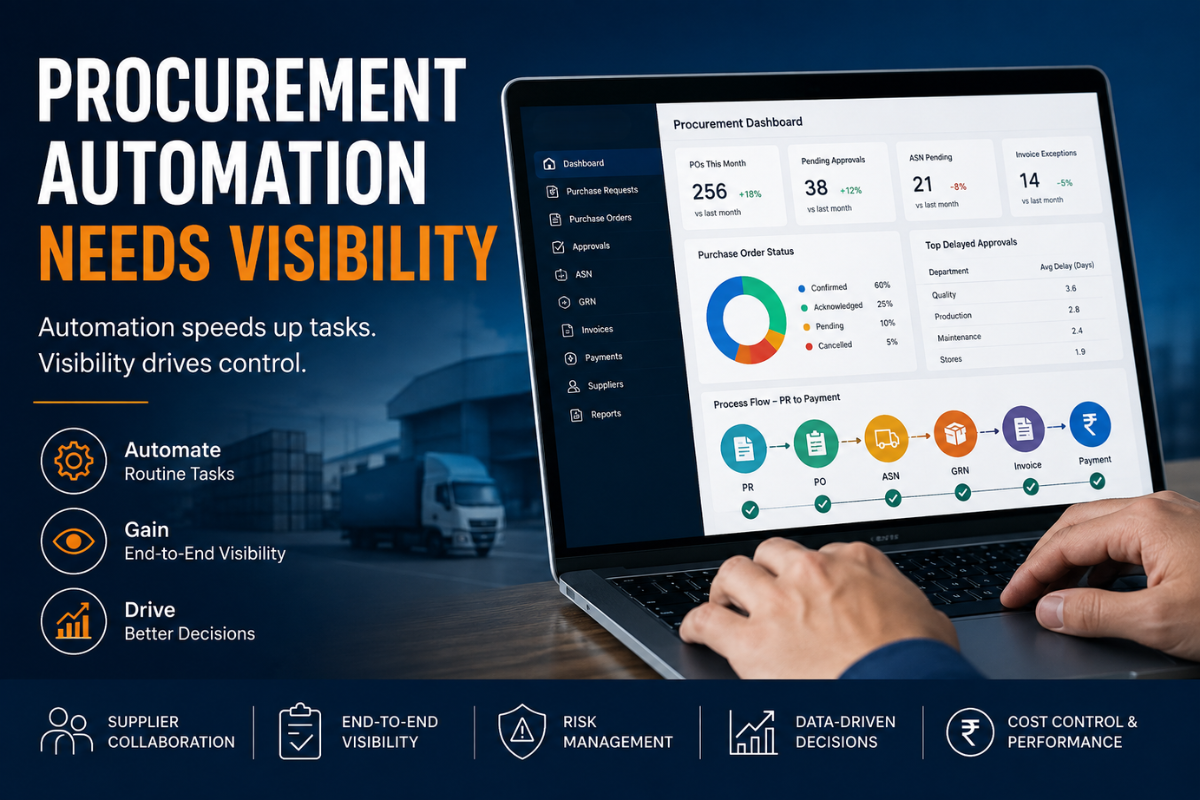
People in charge of procurement have spent many years automating approvals, purchase orders, invoices, and supplier-related processes. Yet a large number of manufacturing companies still encounter the same operational issues: delayed responses, unclear responsibility, manual follow-ups, poor communication with suppliers, and a lack of visibility into where the process actually slows down.
This gap shows an uncomfortable truth: procurement automation is not the same as procurement transformation.
Automation speeds up tasks. Visibility allows procurement to be controlled.
About the Market Shift
In manufacturing, automotive, industrial, and engineering-driven companies, procurement is becoming more complicated. Supplier ecosystems have grown in size, ERP systems are more widely used, and business leaders expect procurement to support cost control, supply continuity, risk management, and operational speed.
Digital procurement is now a boardroom matter, not merely a back-office improvement initiative. The reason is that many digital procurement programmes still focus too closely on workflow automation. They automate individual tasks but do not provide leaders with a complete view of the procurement process.
A purchase order can be generated automatically, approval can be sent digitally, and an invoice can be submitted through a system. Yet if procurement teams do not have visibility into supplier response time, delivery confirmation, ASN status, GRN progress, invoice exceptions, or approval ownership, the enterprise has digitised its processes without gaining operational control.
Why This Matters
The next level of development in procurement will not be determined by the number of tasks that have been automated. Instead, it will be determined by how clearly the organisation can see and manage the entire supplier workflow.
For CIOs, this involves linking ERP stability with supplier-facing agility. For CPOs, it means shifting from manual follow-up to evidence-based accountability. For supply chain leaders, it means detecting supplier delays before they affect production or customer commitments.
This is the difference between automation and transformation.
Automation answers: has the task been completed?
Visibility answers: where is the process stuck, who is responsible for it, and what business risk is emerging?
Key Highlights
- Although procurement automation speeds up tasks, greater process visibility improves enterprise control.
- Approval delays often continue because organisations cannot see bottlenecks clearly.
- Gaps in supplier responses remain hidden when communication takes place by email, phone, or spreadsheets.
- ERP systems are essential systems of record, but supplier collaboration often needs an additional workflow layer.
- Visibility from purchase request through to payment enables procurement, finance, stores, quality, suppliers, and leadership teams to work from a shared operational view.
- AI and predictive procurement rely on structured and reliable workflow data.
- Procurement transformation should be assessed using visibility metrics, not only by the completion of automation.
Industry Context
Procurement is facing pressure from two directions. Businesses want quicker execution and are therefore investing in automation, AI, analytics, supplier portals, and workflows connected to ERP systems. At the same time, supplier risk, material volatility, compliance requirements, and production dependencies are growing.
A new requirement is therefore placed on leadership: procurement must be both quicker and more transparent. These results are hard to achieve when supplier communication is scattered across emails, spreadsheets, phone calls, and separate systems.
For manufacturing companies, the difficulty in gaining visibility is particularly serious because procurement does not stop with the placement of a purchase order. The workflow continues through acknowledgement, delivery scheduling, advance shipping notice, goods received note, quality inspection, invoice processing, payment visibility, and supplier performance review.
If those steps are not visible, procurement leaders have to deal with problems only after they arise.
The Real Difference: Task Automation vs Process Transformation
Many organisations refer to a procurement initiative as “transformation” when they are actually automating tasks.
| Area | Task Automation | Process Transformation |
|---|---|---|
| Primary goal | Complete tasks faster | Improve end-to-end control |
| Scope | Internal workflows | Internal teams and suppliers |
| Visibility | Limited to individual steps | Full PR-to-payment process view |
| Accountability | Department-based | Cross-functional and supplier-facing |
| Data value | Transaction records | Operational intelligence |
| Leadership outcome | Efficiency | Control, resilience, and decision quality |
A digitally generated PO does not ensure that the supplier will acknowledge it. Even with automated invoice routing, a mismatch between the GRN and the invoice can still occur. Similarly, digital approvals do not automatically show why a workflow has been delayed.
Procurement transformation takes place when all stakeholders can see the status, the owner, the reason for any delay, and the next action throughout the workflow.
Why Approval Delays Persist After Automation
Approval procedures are usually the first processes to be automated, but automated routing does not always eliminate approval delays.
The issue is not merely whether the approval request has been passed from one person to another. The question is whether procurement leaders can answer:
- Which approvals are being delayed?
- Who is responsible for the delay?
- Is the delay caused internally or by the supplier?
- Which categories, plants, suppliers, or departments are affected repeatedly?
- How does this affect delivery times, inventory levels, or payment schedules?
Without these answers, procurement teams still have to rely on escalation emails and phone calls. Although the process can be carried out digitally, accountability is still handled manually.
Supplier Response Is the Missing Visibility Layer
In industries where a large number of suppliers are involved, many of the most significant procurement activities take place outside the company.
Suppliers confirm purchase orders. Suppliers confirm when they will deliver. Suppliers send advance shipping notice details. Suppliers answer questions about quality. Suppliers ask about invoices and payments.
If these interactions take place through unstructured channels, procurement loses sight of them. The team may know that a purchase order has been sent, but it may not know whether the supplier has acted on it. Similarly, the team may know that an invoice exists, but it may not know whether the delay is due to a missing goods receipt note, a price mismatch, an approval hold, or clarification from the supplier.
At this point, supplier collaboration becomes a strategic capability rather than just a means of communication.
The product overview offered by Vendora outlines a supplier-facing workflow that includes forecast, supplier readiness, RFQ, PO, vendor acknowledgement, ASN, GRN, quality checks, invoice submission, and payment tracking. The way this workflow is described shows the direction procurement transformation is taking: moving from internal automation to shared process visibility.
The Visibility Metrics Procurement Leaders Should Track
Procurement transformation should be measured by CIOs and CPOs using visibility-led metrics, not only by the level of automation adopted.
| Metric | Strategic Question It Answers |
|---|---|
| PO acknowledgement time | Are suppliers responding within the expected timeframes? |
| Approval cycle time | Where do internal decisions slow down? |
| ASN submission rate | Can delivery teams plan before the goods arrive? |
| GRN processing time | Is the receiving and invoice workflow connected? |
| Invoice exception rate | Where is there misalignment between finance and supplier workflows? |
| Supplier response time | Which suppliers cause repeated delays in communication? |
| Manual follow-up volume | How much unseen work still remains outside the system? |
| Workflow delay by owner | Which team or stakeholder is responsible for the bottleneck? |
| Supplier communication history | Can disputes be settled with a clear audit trail? |
Expert Perspective
[Insert Executive Name, Title], associated with Vendora SCM Software, can include a leadership comment here.
Suggested quote placeholder:
“Procurement teams do not need more isolated automation. What they need is a common view of how work flows among buyers, suppliers, finance, stores, quality, and ERP systems. The next stage in procurement transformation should be judged by visibility, accountability, and the quality of supplier data available for decision-making.”
The executive view should avoid product claims and instead focus on the wider market shift: procurement is becoming a data-driven operating system for supplier ecosystems.
Strategic Playbook for CIOs and CPOs
When procurement leaders are considering automation, they should ask five questions before approving the next technology initiative.
1. Does the system display the complete workflow?
A tool that automates a single task but hides upstream and downstream dependencies will fail to address enterprise-level inefficiency.
2. Are suppliers part of the workflow?
Supplier-facing actions must be structured, trackable, and measurable. Otherwise, supplier collaboration will remain outside the transformation programme.
3. Is the ERP system linked to supplier execution?
ERP systems should remain the official system of record, but procurement leaders also need visibility into supplier actions before and after ERP transactions.
4. Can leadership identify bottlenecks by owner?
Accountability is essential for transformation. If a delay cannot be attributed to a process step, stakeholder, supplier, or exception reason, it cannot be managed effectively.
5. Can the data be used for analytics and artificial intelligence?
AI in procurement relies on structured data. It will have difficulty generating reliable insights if supplier communication and workflow exceptions are scattered across emails and spreadsheets.
About Vendora SCM Software
Vendora SCM Software is a vendor management and supplier collaboration platform designed for large organisations with complicated procurement and supplier workflow requirements. The platform provides facilities for vendor onboarding, supplier portal collaboration, RFQ issuance, purchase order management, delivery scheduling, ASN handling, GRN processing, invoice tracking, payment visibility, supplier communication, vendor performance analytics, and SAP/ERP-connected workflows.
Vendora’s product pages are aimed at mid-sized and large procurement teams that need visibility, control, accountability, and supplier collaboration throughout the purchasing process.
Conclusion:
The procurement function is now entering a new stage. The initial phase of digitisation was concerned with taking over manual tasks. The following phase will focus on making the entire supplier workflow visible, measurable, and intelligent.
This change matters because procurement is no longer evaluated solely on cost savings or administrative efficiency. It is now being judged more on resilience, speed, supplier performance, risk visibility, and the quality of the decisions it supports.
Automation can carry out a task.
Visibility can change how the enterprise operates.
That is the true transformation agenda for CIOs and CPOs.
FAQs
What is procurement process visibility?
Why is automation alone not enough in procurement?
How does supplier collaboration improve procurement visibility?
Why is ERP integration important for procurement transformation?
Content ownership: Vendora SCM Software Editorial Team
Subject-matter review: Procurement, Vendor Management & ERP Implementation Team
Last reviewed: 19 August 2026
Review scope: This article was reviewed for procurement workflow accuracy, supplier collaboration relevance, ERP/SAP context, manufacturing procurement applicability, and factual clarity.
Learn more about Vendora’s company background and implementation experience on the About Us page.
![A modern smartphone showing the [Vendor Portal Management System] dashboard for on-the-go vendor collaboration.](https://www.vendorascmsoftware.com/wp-content/themes/vendora/images/phone.webp)
