

Executive Summary
Enterprise Resource Planning (ERP) systems have long served as the operational backbone of procurement, centralizing transactions, financial records, and business processes. However, as procurement becomes more strategic, organizations are discovering that ERP alone cannot deliver the agility, visibility, and intelligence required to navigate increasingly complex supply chains.
Modern procurement leaders need more than a system of record—they need a system of intelligence.
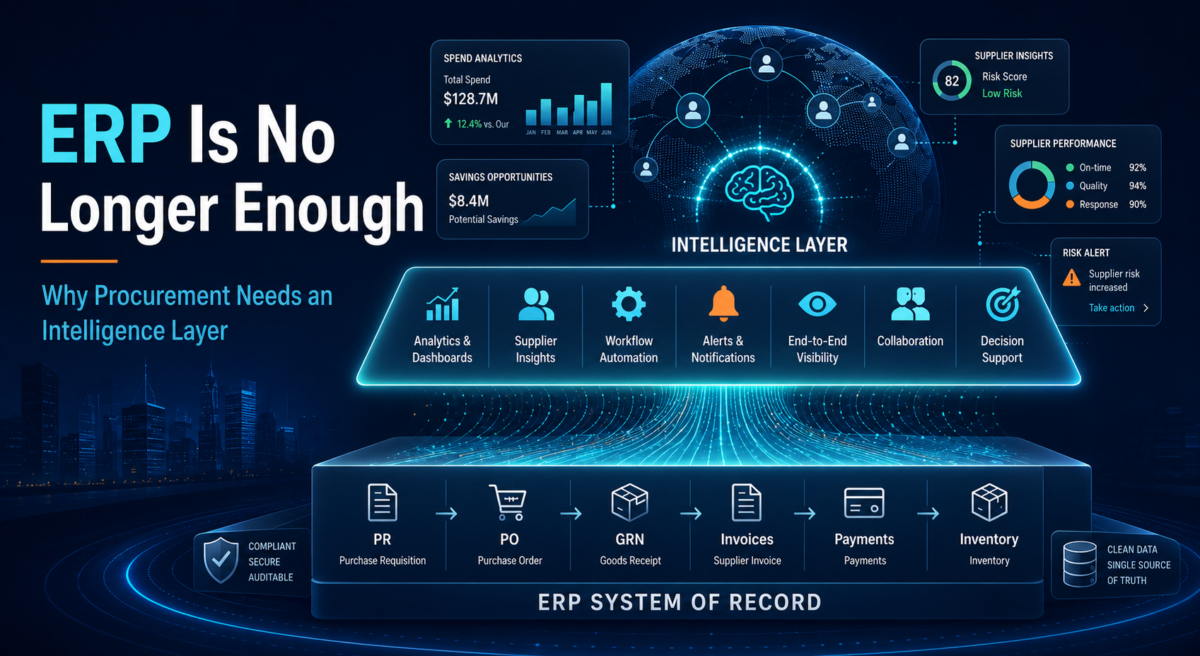
An intelligence layer sits above existing ERP investments, connecting data, automating contextual workflows, surfacing actionable insights, and enabling better procurement decisions without replacing core enterprise systems.
This article introduces the Procurement Intelligence Stack™, a framework that explains why the future of procurement lies in augmenting ERP with intelligent decision capabilities rather than replacing it.
ERP records transactions. An intelligence layer explains what they mean and what should happen next.
Introduction
For decades, ERP implementations have been synonymous with digital transformation. Organizations invested millions in integrating procurement, finance, inventory, and manufacturing into a single platform, expecting streamlined operations and better control.
Those investments remain valuable.
However, procurement has evolved faster than ERP architecture.
Supplier ecosystems have expanded globally. Procurement teams are expected to manage supplier risk, sustainability, compliance, cost optimization, and resilience—all while responding faster to business needs.
Yet many procurement professionals still rely on spreadsheets, email chains, and manual follow-ups to bridge gaps that ERP systems were never designed to solve.
The issue isn’t that ERP has failed.
It’s that ERP was designed to manage transactions, not enable intelligent procurement decisions.
ERP Is Excellent at Recording the Past
ERP systems excel at maintaining operational consistency.
They efficiently manage:
- Purchase Requisitions (PRs)
- Purchase Orders (POs)
- Goods Receipt Notes (GRNs)
- Invoice matching
- Financial postings
- Inventory updates
These capabilities remain essential for enterprise operations.
However, ERP primarily answers questions like:
- What was purchased?
- Who approved it?
- When was payment processed?
Modern procurement teams increasingly need answers to different questions:
- Which suppliers consistently delay deliveries?
- Where are approval bottlenecks forming?
- Which purchases require executive attention?
- Which vendors present compliance risks?
- Which procurement activities threaten production schedules?
These questions require context, relationships, and predictive insights—not simply transaction records.
The Missing Intelligence Layer
Think of ERP as the organization’s memory.
An intelligence layer acts as its decision engine.
Rather than replacing ERP, it connects with existing enterprise systems to provide:
- End-to-end procurement visibility
- Intelligent approval workflows
- Supplier performance insights
- Exception management
- Real-time procurement dashboards
- Cross-functional collaboration
- Predictive alerts
- Process recommendations
This approach allows organizations to preserve ERP investments while dramatically improving procurement performance.
Digital procurement isn’t about adding another platform. It’s about making existing systems smarter.
Why Procurement Complexity Outgrew Traditional ERP
Industrial procurement has changed significantly over the past decade.
Manufacturing, automotive, aerospace, engineering services, and defense organizations now manage thousands of suppliers across multiple geographies while balancing cost, quality, compliance, and operational continuity. Procurement leaders also face growing expectations for transparency, audit readiness, and cross-functional collaboration.
These demands expose limitations that transaction-focused systems cannot solve alone.
Common challenges include:
- Limited visibility into procurement status
- Manual document handling
- Delayed approvals
- Disconnected supplier communication
- Difficulty tracking procurement from requisition to payment
These challenges are not simply workflow issues—they are information challenges.
Without contextual intelligence, procurement teams spend valuable time finding answers instead of making decisions.
The Procurement Intelligence Stack™
Organizations should think of procurement technology as a layered architecture rather than a single platform.
| Layer | Purpose |
|---|---|
| ERP | System of record for transactions and financial control |
| Workflow Automation | Standardizes procurement processes and approvals |
| Intelligence Layer | Generates insights, recommendations, visibility, and decision support |
| Business Leadership | Uses intelligence to optimize procurement strategy |
Each layer builds on the previous one.
The intelligence layer does not duplicate ERP functionality.
Instead, it enriches ERP data by connecting people, workflows, supplier interactions, and operational insights into a unified decision environment.
Organizations that adopt this layered approach gain faster approvals, improved supplier collaboration, stronger governance, and better procurement visibility without disrupting existing ERP investments.
Practical Recommendations
Procurement leaders should focus on extending—not replacing—their ERP ecosystem.
Evaluate Decision Gaps Instead of Feature Gaps
Identify where procurement teams leave ERP to complete work manually.
Improve Procurement Visibility
Provide stakeholders with real-time views across requisitions, purchase orders, approvals, deliveries, invoices, and payments.
Connect Supplier Collaboration
Enable structured communication rather than relying on scattered email conversations.
Automate Repetitive Operational Tasks
Reserve human expertise for supplier negotiations, sourcing strategy, and exception management.
Measure Procurement Intelligence
Track metrics such as:
- Approval cycle time
- Supplier responsiveness
- Exception frequency
- Procurement visibility
- Decision turnaround time
These indicators provide a more complete view of procurement maturity than transactional metrics alone.
Common Mistakes
Organizations often undermine procurement transformation by:
- Expecting ERP to solve every procurement challenge
- Adding disconnected point solutions without integration
- Measuring system utilization instead of decision quality
- Overlooking supplier collaboration
- Prioritizing automation before improving procurement visibility
Technology should simplify decision-making—not create additional complexity.
Future Outlook
Artificial intelligence, predictive analytics , and autonomous procurement will continue to reshape enterprise purchasing.
However, these technologies require clean data, standardized workflows, and connected procurement processes to deliver meaningful outcomes.
The organizations that benefit most from AI won’t necessarily be those with the newest ERP systems.
They will be those that build an intelligence layer capable of transforming operational data into actionable decisions.
As procurement evolves from an operational function to a strategic business partner, intelligence—not transactions—will become the primary source of competitive advantage.
Key Takeaways
- ERP remains essential but functions primarily as a system of record.
- Modern procurement requires an intelligence layer to support faster, data-driven decisions.
- Visibility, collaboration, and contextual insights are becoming strategic procurement capabilities.
- Organizations should extend ERP rather than replace it.
- The Procurement Intelligence Stack™ provides a practical roadmap for building intelligent procurement operations.
Conclusion:
ERP transformed enterprise operations by standardizing transactions and establishing a single source of truth. But procurement’s role has expanded beyond processing purchases to managing risk, enabling resilience, and driving strategic value.
Meeting these expectations requires more than efficient transaction management. It requires intelligence.
By layering contextual insights, workflow orchestration, and real-time visibility on top of existing ERP systems, organizations can unlock faster decisions, stronger supplier relationships, and more resilient procurement operations.
In the years ahead, competitive advantage will belong not to organizations with the largest ERP deployments, but to those that combine trusted operational data with intelligent decision-making.
![A modern smartphone showing the [Vendor Portal Management System] dashboard for on-the-go vendor collaboration.](https://www.vendorascmsoftware.com/wp-content/themes/vendora/images/phone.webp)
