

Managing suppliers becomes increasingly difficult when vendor information, documents, purchase orders, forecasts, invoices, and communication are spread across multiple processes and platforms.
For a leading engineered manufacturing group serving customers in India and global OEMs, the procurement team needed better control over vendor-related activities. The procurement head faced challenges involving multiple vendor logins, quality documents, forecasts, payment and invoice communication, purchase order transactions, and vendor performance evaluation.
The organization implemented Vendora’s automated vendor onboarding and PO transaction solution to move key supplier-management activities into a structured digital workflow.
The implementation helped the organization move from paper-based processes toward digital vendor collaboration while improving supplier information visibility, vendor evaluation, and PO transaction tracking.
About the Customer
The customer is a leading manufacturing group with capabilities spanning the design, development, customization, manufacture, supply, and support of specialized engineered solutions for customers in India and leading OEMs worldwide.
This type of manufacturing environment requires procurement teams to coordinate with suppliers while maintaining visibility over:
- Vendor information
- Quality-related documents
- Forecast information
- Purchase orders
- Invoice and payment communication
- Supplier performance
- Vendor compliance-related information
As supplier interactions increased, managing these activities through fragmented processes became a challenge for the procurement function.
The Business Challenge
Fragmented Vendor Management
The procurement head faced difficulty managing multiple logins associated with a single vendor and maintaining supplier-related information across different activities.
This created additional effort for teams that needed to locate, review, and communicate vendor information.
Manual Vendor Documentation
Vendors were required to provide quality manuals and other documents. Managing these documents and ensuring that relevant information remained available to the appropriate teams required a more structured process.
Forecast and Procurement Communication
Monthly and annual forecast activities also required coordination between the organization and its suppliers.
Without a connected workflow, supplier communication can become dependent on repeated follow-ups and separate communication channels.
PO, Invoice, and Payment Communication
Purchase-order transactions, invoice communication, and payment-related discussions were additional areas where supplier interaction needed better coordination.
Vendor Performance Evaluation
The procurement team also needed a structured way to evaluate vendors and understand supplier performance.
The challenge was therefore broader than vendor registration alone. The organization needed a more connected approach to supplier management.
Previous Process vs. New Process
| Before Vendora | With Vendora |
|---|---|
| Paper-based vendor processes | Digital vendor onboarding workflow |
| Vendor information spread across activities | Unified supplier information |
| Multiple vendor communication points | More structured supplier communication |
| Manual document handling | Digital document upload and management |
| Manual contract follow-up | Contract-expiry reminders |
| Limited structured vendor evaluation | Periodic vendor evaluation using a scorecard |
| Manual PO transaction follow-up | Better PO transaction visibility |
| Manual delivery-status tracking | Improved visibility into delivery status |
| Limited supplier-performance visibility | Better vendor performance and quality insights |
The source specifically reports that Vendora helped the organization migrate from paper to digital processes, communicate relevant information with vendors, manage contract documents and expiry reminders, and conduct periodic vendor evaluation using a vendor scorecard.
The Vendora Solution
1. Automated Vendor Onboarding
Vendora was implemented to automate the vendor onboarding process and provide a structured way to manage supplier information.
Instead of relying entirely on paper-based processes, the organization could move supplier interactions into a digital workflow.
This created a more structured foundation for subsequent vendor-management activities.
2. Digital Supplier Communication
Vendora enabled the organization to share relevant information with vendors and maintain communication around supplier commitments and priorities.
The objective was not simply to digitize communication, but to create a more structured relationship between the organization and its suppliers.
3. Vendor Scorecard and Evaluation
Vendora provided the organization with a structured way to evaluate vendors and track their performance.
This included tracking delivery times, quality, compliance with contract terms, and overall service levels.
The scorecard offered insights into vendor performance, enabling the procurement team to make data-driven decisions when managing supplier relationships.
4. PO Transaction Management
Vendora improved the management of purchase-order transactions by providing a centralized view of all PO-related activities.
This included tracking purchase orders, delivery status, and invoice communication, which helped reduce manual follow-ups and support timely procurement activities.
5. Contract and Document Management
Vendora streamlined the management of vendor contracts and related documents.
Key features included automatic contract-expiry reminders, digital document storage, and secure access to relevant information for both the organization and its suppliers.
This significantly reduced the risk of missing contract renewals or important compliance-related documents.
6. Reporting and Analytics
Vendora provided real-time reporting and analytics on vendor performance, PO transactions, and communication activities.
This enabled the procurement team to monitor supplier relationships and make informed decisions in a timely manner.
Contract Document Management
The solution enabled the organization to:
- Upload contract documents
- Set reminders for contract expiry
- Monitor contract-related requirements
- Support vendor adherence to agreed SLAs
This provided procurement teams with a more structured approach to managing important supplier documentation and contract-related follow-ups.
Vendor Evaluation and Scorecard
Vendora provided a periodic formal vendor-evaluation process through a vendor scorecard.
The scorecard could reflect vendor compliance-policy issues and provide a structured basis for reviewing supplier performance.
This helped procurement teams move beyond simply maintaining a vendor list toward actively reviewing supplier performance.
Controlled User Access
The implementation also included privileged-user mapping.
This was designed to provide greater control over elevated access and permissions for users, accounts, and processes and reduce the risk of inappropriate use of privileged access.
PO Transaction and Delivery Visibility
The implementation improved visibility into supplier-related transactions, including PO transactions and delivery status.
This reduced dependence on manual status tracking and helped users work with supplier information through a more connected process.
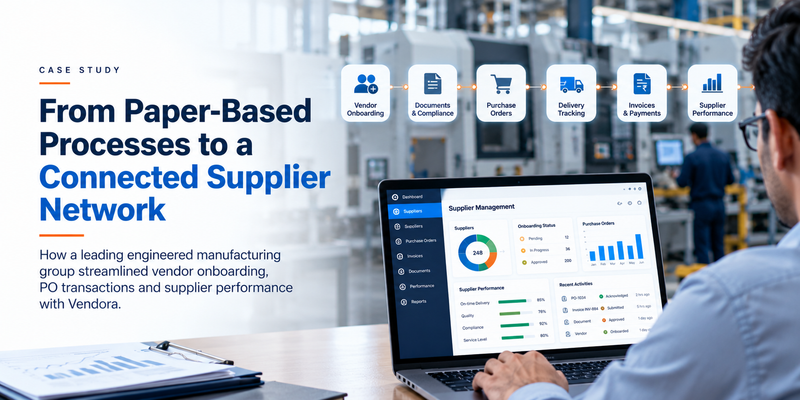
How the Workflow Changed
The implementation can be understood as a connected supplier-management flow:
- Vendor Onboarding
- Supplier Information & Documents
- Vendor Communication
- RFQ / Procurement Activities
- Vendor Evaluation
- PO Transactions
- Delivery Visibility
- Supplier Performance Review
This approach connects vendor information and procurement activities rather than treating onboarding as an isolated registration step.
Results and Business Impact
The case study reports several qualitative outcomes from the implementation.
360° Supplier Visibility
The organization gained a 360° overview of supplier data and performance reports, helping teams access supplier information in a more consolidated manner.
Better Vendor Comparison
The solution supported comparison of vendors based on:
- Quality
- Capability
- Costing
This provided procurement teams with more information for supplier selection and evaluation.
Unified Supplier Records
Vendora helped maintain a unified supplier record, giving teams greater confidence in the information available for vendor-related activities.
Stronger Supplier Collaboration
The implementation strengthened collaboration between the organization and its suppliers by providing a more structured digital environment for communication and information exchange.
Faster Supplier Onboarding
The case study reports faster supplier onboarding and the ability to work in real time with greater visibility.
Important Evidence Note
The source does not provide a verified percentage for time savings, cost reduction, ROI, or productivity improvement.
Therefore, no numerical performance claim is made here.
Key Benefits Achieved
- Automated vendor onboarding
- Migration from paper-based to digital vendor processes
- Centralized supplier information
- Better supplier-data visibility
- Structured supplier communication
- Contract-document management
- Contract-expiry reminders
- Periodic vendor evaluation
- Vendor scorecard-based performance review
- Better quality and compliance visibility
- Improved vendor comparison
- Better PO transaction visibility
- Improved delivery-status visibility
- Stronger supplier collaboration
- Controlled privileged-user access
Why This Implementation Matters for Manufacturing Procurement
For manufacturing organizations, vendor management is closely connected to procurement execution.
A supplier may need to provide:
- Vendor information
- Documents
- Commercial information
- Purchase-order response
- Delivery information
- Performance information
When these activities are managed separately, procurement teams may spend additional time following up with suppliers and locating information.
The Vendora implementation demonstrates a different approach: connecting supplier onboarding, information management, communication, vendor evaluation, and procurement-related activities through a structured digital workflow.
Lessons Learned
1. Vendor Onboarding Should Be More Than Registration
A supplier-management process should provide a foundation for future procurement activities, not simply collect initial vendor details.
2. Supplier Information Needs to Remain Accessible
Centralized supplier information makes it easier for procurement teams to review vendor details and performance information.
3. Vendor Evaluation Should Be Structured
A formal vendor scorecard gives procurement teams a consistent framework for periodic supplier evaluation.
4. Documents Need Active Management
Uploading supplier documents is only one part of document management. Contract-expiry reminders and compliance-related follow-up help keep supplier information actionable.
5. Supplier Communication Benefits From Structure
A structured digital communication process can reduce dependence on fragmented communication channels.
6. Procurement Visibility Goes Beyond the Purchase Order
The status of a purchase order, the delivery timeline, how well a vendor is performing, and supplier details are all connected parts of the procurement process.

