

For years, supplier portals have been presented as the answer to fragmented supplier communication. They solved an important problem: giving suppliers a digital place to submit information, respond to buyers, and access procurement-related activities.
But the enterprise procurement challenge has moved on.
A portal can digitize an interaction without actually connecting the process behind it. If a supplier acknowledges a purchase order in one system, while procurement updates another system manually and finance works from a separate record, the organization has digitized the interface without creating a connected supplier network.
The next stage is different.
An intelligent supplier network connects suppliers, procurement teams, enterprise systems, and operational workflows so that information can move through the supplier lifecycle with the context required for better decisions.
The strategic question for CIOs and CPOs is therefore no longer:
Do we have a supplier portal?
It is:
Can our supplier network turn supplier interactions into connected, usable business information?
What Is an Intelligent Supplier Network?
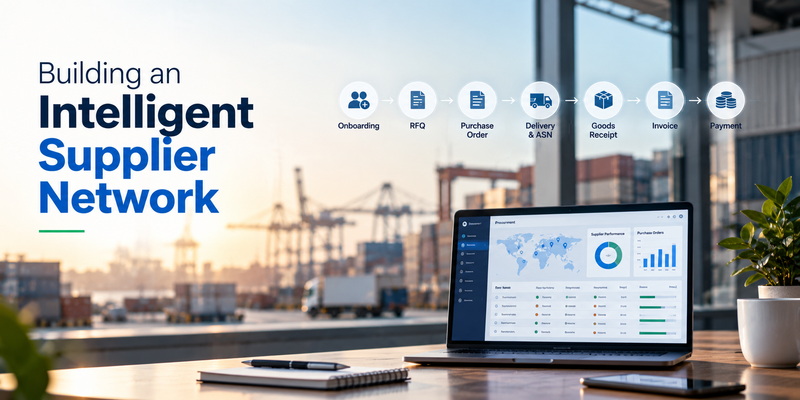
An intelligent supplier network is a connected digital environment that allows suppliers, buyers, procurement teams, finance, operations, and enterprise systems to exchange information across the supplier lifecycle.
A mature network can connect:
- Supplier Onboarding
- RFQ
- Purchase Order
- PO Acknowledgement
- Advance Shipping Notice
- Goods Receipt
- Invoice
- Payment
- Supplier Performance
The important distinction is that these are not treated as isolated transactions.
Information generated at one stage can provide context for the next.
For example, a purchase order acknowledgement can influence delivery planning. Delivery information can affect receiving. Receiving information can affect invoice processing. Supplier performance data can influence future sourcing decisions.
That is what makes the network strategically useful.
Why a Supplier Portal Alone Is Not Enough
A supplier portal can provide self-service access.
But self-service is only one part of supplier collaboration.
Consider a typical enterprise environment.
A supplier submits onboarding information through a portal.
The procurement team reviews it.
The approved information is transferred into an ERP.
Later, the supplier receives a purchase order.
The supplier confirms it.
A delivery update is sent.
The receiving team records the goods receipt.
Finance processes the invoice.
Each stage may involve a different application or department.
If those systems are poorly connected, employees still have to reconstruct what happened.
The result is a familiar pattern:
Digital interaction → manual reconciliation → repeated follow-up → delayed decision
An intelligent supplier network aims for:
Digital interaction → connected workflow → shared status → informed action
The Five Stages of Supplier Network Maturity
Enterprises should think about supplier-network development as a maturity journey.
Stage 1: Email and Spreadsheets
Supplier relationships are managed through:
- Excel
- Phone calls
- Shared folders
- Manual follow-ups
Information depends heavily on individual employees.
The key question is:
Where is the latest information?
Stage 2: Supplier Portal
The organization introduces a supplier-facing digital portal.
Suppliers can submit information or interact with selected procurement activities online.
This reduces dependence on email for some processes.
But the portal may still be isolated from the wider procurement environment.
The key question becomes:
Can suppliers interact with us digitally?
Stage 3: Connected Workflows
The supplier portal becomes connected to procurement processes.
Supplier activity can flow into workflows such as:
- RFQ
- Purchase orders
- Delivery schedules
- ASN
- GRN
- Invoice
- Payment
The question changes to:
Can supplier activity move through the procurement workflow?
Stage 4: Integrated Supplier Network
Supplier workflows connect more closely with ERP and enterprise systems.
The ERP remains an important system of record, while a supplier-facing collaboration layer helps suppliers and internal users interact with relevant procurement processes.
This is particularly important in organizations running SAP, Oracle, or other ERP environments.
The question becomes:
Can supplier activity connect with the systems that run our business?
Stage 5: Intelligent Supplier Ecosystem
At the highest maturity level, the enterprise begins using connected supplier data for decision support.
The focus shifts toward:
- Exception identification
- Supplier-performance trends
- Risk indicators
- Predictive analysis
- Prioritized actions
- Procurement decision support
The question becomes:
What does our supplier data tell us to do next?
Supplier Data Is the Foundation
An intelligent supplier network cannot compensate for poor supplier data.
Before introducing advanced analytics or AI, organizations need reasonably reliable information about:
- Supplier identity
- Supplier categories
- Products and services
- Locations
- Commercial relationships
- Procurement transactions
- Documents
- Performance
- Risk indicators
- Approvals
This creates an important principle:
Data quality is a procurement capability, not just an IT responsibility.
If supplier information is duplicated, outdated, incomplete, or disconnected from transactions, the organization will struggle to generate reliable insight from it.
CIOs should therefore treat supplier-data governance as part of the digital procurement architecture.
Real-Time Information Changes Supplier Collaboration
Traditional supplier management often depends on questions being asked one at a time.
For example:
Has the supplier acknowledged the PO?
Then:
Has the shipment been dispatched?
Then:
Has the ASN been submitted?
Then:
Has the material been received?
Then:
Has the invoice been processed?
Each question creates another communication event.
A connected supplier network can provide a more continuous view:
- PO Issued
- Acknowledged
- Shipment Planned
- ASN
- Delivery
- GRN
- Invoice
- Payment
Vendora’s platform, for example, connects supplier-facing workflows around PO, ASN, GRN, invoice, and payment visibility as part of its broader procurement workflow model.
The benefit is not simply having more information.
It is reducing uncertainty about what is happening now.
Interoperability Matters
Large enterprises rarely run procurement through a single application.
The technology environment may include:
- ERP
- Procurement software
- Finance systems
- Supplier portals
- Quality applications
- Logistics systems
- Analytics platforms
The answer is not necessarily to replace everything.
Instead, organizations need to determine which system is responsible for which part of the process.
- ERP
- System of record
- Supplier Collaboration Layer
- Supplier-facing interaction and workflow
- Analytics Layer
- Analysis and decision support
- Business Teams
- Decision-making and intervention
This architecture allows enterprises to improve supplier collaboration without turning the supplier portal into another isolated database.
Vendora describes itself as an ERP/SAP-connected supplier collaboration layer rather than an ERP replacement.
Supplier Experience Is Part of the Network
Supplier experience is often discussed as a user-interface issue.
It is actually a lifecycle issue.
A supplier experiences an enterprise through multiple interactions:
- Registration
- Onboarding
- Document submission
- RFQ response
- PO acknowledgement
- Delivery communication
- ASN
- Invoice submission
- Payment queries
- Issue resolution
If each interaction requires a separate channel, suppliers face friction.
A better supplier network makes the relationship more predictable.
The goal is not to make every interaction identical.
The goal is to give suppliers clear requirements, visible status, and structured communication.
The Hidden Value of Connecting Procurement Events
A purchase order is not an isolated document.
It sits inside a chain of related events.
- Purchase Order
- Supplier acknowledgement
- Delivery schedule
- ASN
- Goods receipt
- Quality process
- Invoice
- Payment
When these events are disconnected, procurement teams may have to manually reconstruct the status of a transaction.
When they are connected, new questions become possible:
- Which suppliers have not acknowledged their POs?
- Which deliveries are approaching risk?
- Which ASNs are missing?
- Which invoices are waiting for action?
- Where are exceptions accumulating?
- Which suppliers repeatedly miss commitments?
This is where supplier collaboration begins to produce operational intelligence.
From Connected Data to Better Decisions
The progression from data to intelligence can be understood in four stages.
Descriptive
What happened?
Example:
Which suppliers delivered late?
Diagnostic
Why did it happen?
Example:
Was the delay related to capacity, logistics, quality, or planning?
Predictive
What might happen next?
Example:
Which open orders appear more likely to miss their delivery commitment?
Prescriptive
What should procurement do?
Example:
Which supplier exception should the procurement team address first?
This progression is more important than simply adding dashboards.
Where AI Fits
AI can potentially become useful once supplier data and workflows are sufficiently connected.
Possible applications include:
Supplier Risk Analysis
Identify patterns across supplier activity and available risk indicators.
Exception Prioritization
Help procurement teams focus on events that may require intervention.
Supplier Performance Analysis
Identify recurring delivery, quality, responsiveness, or transaction patterns.
Document Intelligence
Assist with extracting or classifying information from supplier documents.
Decision Support
Surface relevant supplier and procurement information for human review.
But AI should not replace procurement judgment.
A useful model is:
Reliable Data + Business Context + Connected Workflow + Human Review
Without those foundations, adding AI may simply make poor information easier to process at scale.
What CIOs Should Ask
For CIOs, supplier-network transformation is primarily an architecture and governance challenge.
Ask:
- Where is supplier master data maintained?
- Which system is the source of truth?
- How does supplier information move between systems?
- How are supplier-facing workflows connected to ERP?
- How are permissions managed?
- How are data changes synchronized?
- How are exceptions surfaced?
- Can the architecture scale across plants and business units?
- What information should suppliers be allowed to access?
- How will adoption and data quality be measured?
What CPOs Should Ask
For procurement leaders, the questions are more operational.
Ask:
- How much supplier communication still happens through email?
- How much time is spent checking PO status?
- Can suppliers see what action is required?
- How quickly can procurement identify exceptions?
- Can supplier performance be connected to actual transactions?
- Can procurement compare suppliers using current information?
- Does onboarding connect with ongoing supplier management?
- Can teams see the supplier lifecycle from onboarding through payment?
The answers reveal whether the organization has a digital portal or a genuinely connected supplier network.
A Practical Supplier Network Maturity Model
| Level | Operating Model | Primary Value |
|---|---|---|
| 1. Manual | Email + spreadsheets | Basic communication |
| 2. Digital Portal | Supplier self-service | Digital interaction |
| 3. Connected Workflow | Portal + procurement workflows | Transaction visibility |
| 4. Integrated Network | Supplier workflows + ERP | Connected execution |
| 5. Intelligent Ecosystem | Connected data + analytics/AI | Decision support |
Organizations do not need to jump directly from Level 1 to Level 5.
A more practical progression is:
- Digitize
- Standardize
- Connect
- Integrate
- Analyze
- Predict
How to Start Building an Intelligent Supplier Network
Step 1: Map the Supplier Lifecycle
Document the major interactions from onboarding through payment.
Step 2: Identify Information Gaps
Find where supplier information is duplicated, delayed, or unavailable.
Step 3: Define System Ownership
Determine which system owns supplier master data, procurement transactions, financial information, and operational records.
Step 4: Connect High-Value Workflows
Start with high-volume interactions such as:
- RFQ
- PO
- ASN
- GRN
- Invoice
- Payment queries
Step 5: Measure Supplier Adoption
Track whether suppliers actually use the digital processes provided to them.
Step 6: Introduce Exception Management
Once transaction visibility improves, identify which events require human intervention.
Step 7: Add Analytics and AI Carefully
Use reliable, connected data as the foundation for advanced analytics and AI-assisted decision support.
Where Vendora Fits
Vendora provides one example of the supplier collaboration and workflow layer within this architecture.
Its platform supports vendor onboarding, RFQ, purchase orders, ASN, GRN, invoice tracking, payment visibility, reporting, analytics, ticketing, and buyer-vendor communication around ERP/SAP-backed procurement processes.
The distinction is important.
Vendora does not position itself as an ERP replacement. It provides a supplier-facing collaboration and workflow environment that can work around ERP-backed procurement and finance records.
For enterprises, that illustrates a broader architectural principle:
The objective is not to replace every existing system. It is to connect the supplier interactions that matter most to the systems and decisions that run the business.

