

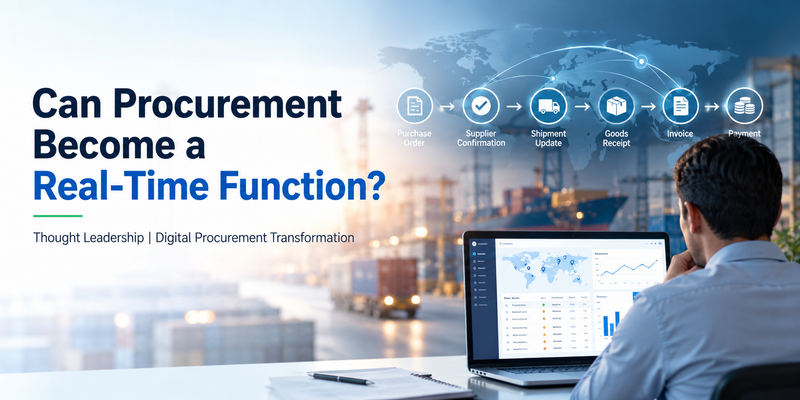
Procurement has traditionally operated on a reporting cycle.Teams review weekly purchase-order reports, monthly supplier-performance summaries, periodic spend analysis, and retrospective exception reports. By the time an issue appears in a management report, the opportunity to influence the outcome may already be narrowing.The question is not whether procurement has enough reports.The question is whether procurement has enough current information to act while there is still time to influence the outcome.Connected supplier data creates that possibility.When supplier responses, purchase orders, delivery commitments, shipment updates, goods receipts, invoices, and other procurement events are connected, procurement can move closer to a continuous operating model.That raises a more important question for CPOs and CIOs:
This creates a fundamental shift:
The progression is important.Organizations should not try to implement predictive procurement before establishing basic transaction visibility.A practical sequence is:
Can procurement become a real-time function?
The answer is yes—but real-time procurement is not simply a dashboard that refreshes every few minutes.It requires connected data, clear ownership, workflow visibility, exception management, and the ability to act on information quickly.What Does Real-Time Procurement Actually Mean?
Real-time procurement means having sufficiently current information about supplier and purchasing activity to identify important changes, exceptions, and required actions while they can still influence the business outcome.This distinction matters.Real-time does not mean that every procurement decision must happen instantly.A strategic sourcing decision may take weeks.A supplier qualification process may require several reviews.A contract negotiation may require multiple stakeholders.But some procurement events are time-sensitive.For example:- A supplier has not acknowledged a critical PO.
- A delivery commitment has changed.
- An ASN has not been submitted.
- A shipment is delayed.
- A goods receipt is pending.
- An invoice is blocked.
- A supplier repeatedly misses commitments.
Why Procurement Still Runs on Yesterday’s Information
Many procurement organizations have already invested in ERP systems, procurement applications, analytics platforms, and workflow automation.Yet information can still become fragmented.Consider a typical transaction.The ERP records the purchase order.The supplier responds through email.The delivery update arrives through a phone call.The logistics team has another tracking system.The receiving team records the GRN.Finance sees the invoice in another workflow.Procurement then has to bring these pieces together to understand what is happening.The enterprise may have plenty of data.But it may not have a shared operational view.That distinction explains why organizations can have sophisticated systems and still depend heavily on manual follow-ups.Real-Time Procurement Starts With Supplier Visibility
Procurement does not operate entirely inside the enterprise.A large part of the process happens with suppliers.Suppliers:- Confirm purchase orders
- Confirm delivery dates
- Provide shipment information
- Submit ASN details
- Respond to quality questions
- Submit invoices
- Raise payment queries
PO sent
but not:- PO acknowledged
- Supplier committed to a new delivery date
- Shipment has been dispatched
- ASN is missing
From Purchase Order Visibility to Transaction Visibility
A purchase order is only one event in a larger procurement process.Consider:- PO Issued
- Supplier Acknowledgement
- Delivery Schedule
- ASN
- Delivery
- GRN
- Quality Check
- Invoice
- Payment
Where is the transaction now?
rather than:Was the PO created?The Role of Exception-Based Management
Real-time procurement does not mean procurement employees should constantly watch every transaction.That would simply replace one manual problem with another.The better model is exception-based management.Instead of asking employees to monitor everything, the system identifies events that require attention.For example:Normal
Supplier acknowledges the PO within the expected timeframe.No intervention required.Exception
Supplier has not acknowledged a high-priority PO.Procurement action required.Normal
Shipment arrives according to the committed schedule.No intervention required.Exception
Delivery commitment changes significantly.Procurement review required.Monitor everything manually becomes Monitor exceptions systematically
The objective is not more alerts.It is better prioritization.Real-Time Does Not Mean Real-Time Everything
Not every data point deserves an immediate notification.If employees receive alerts for every minor change, the organization creates another problem: alert fatigue.A useful real-time procurement architecture should distinguish between:- Information
- Something changed.
- Exception
- Something changed outside the expected condition.
- Risk
- The change could affect an important business outcome.
- Action
- A specific person needs to respond.
- Event
- Exception
- Risk
- Owner
- Action
Live Supplier-Performance Indicators
Supplier performance is another area where real-time information can change procurement management.Traditional supplier reviews often look backward.For example:“What was this supplier’s delivery performance last quarter?”
That remains useful.But procurement also needs to know:“What is happening with this supplier now?”
Relevant indicators may include:- Delivery commitments
- PO acknowledgement
- Shipment status
- Quality outcomes
- Open issues
- Invoice-related exceptions
- Response activity
- Repeated delays
The CIO Perspective: Real-Time Procurement Is an Architecture Problem
For CIOs, the challenge is not simply buying a real-time dashboard.The underlying architecture needs to support information movement.A typical enterprise may have:- ERP
- Procurement Systems
- Supplier Collaboration
- Logistics
- Finance
- Analytics
- Where does supplier data originate?
- Which system is the source of truth?
- How frequently is information synchronized?
- Which events should trigger workflows?
- How are exceptions communicated?
- How are permissions controlled?
- How is historical information retained?
- How does the architecture scale across plants and business units?
The CPO Perspective: Real-Time Procurement Is a Decision Problem
For the CPO, the question is different.The goal is not to know everything.It is to know what matters now.A procurement leader may want immediate visibility into:- Critical supplier delays
- Unacknowledged POs
- Delivery exceptions
- Quality problems
- Invoice bottlenecks
- High-risk suppliers
- Repeated supplier failures
- Supplier delay detected
- Affected POs identified
- Procurement owner notified
- Supplier contacted
- Alternative action evaluated
Real-Time Procurement Requires Clear Ownership
Information is only useful when someone is responsible for acting on it.Every important exception should have:- An owner
- A priority
- A due date
- A defined action
- An escalation path where necessary
- Information
- Responsibility
- Action
- Outcome
The Difference Between Visibility and Foresight
Real-time procurement is not the same as predictive procurement.They are related, but different.- Visibility
- What is happening now?
- Analytics
- What has been happening?
- Prediction
- What might happen next?
- Prescriptive Decision Support
- What should we do about it?
Where AI Fits Into Real-Time Procurement
AI can potentially make real-time procurement more useful by helping teams interpret large amounts of connected information.Potential applications include:Exception Prioritization
Identify which procurement exceptions may deserve immediate attention.Supplier Risk Signals
Identify patterns that could indicate increasing supplier risk.Delivery Prediction
Use historical and current information to identify potential delivery problems.Supplier Performance Analysis
Identify recurring patterns across supplier activity.Procurement Decision Support
Surface relevant information when procurement teams are evaluating a decision.But AI does not remove the need for reliable data.The foundation remains:Reliable Data + Connected Workflows + Business Context + Human Judgment
Without these elements, AI may simply process incomplete or disconnected information faster.A Practical Real-Time Procurement Maturity Model
| Level | Operating Model | What Procurement Can See |
|---|---|---|
| 1. Periodic Reporting | Weekly/monthly reports | What happened |
| 2. Digital Visibility | Centralized dashboards | Current status |
| 3. Real-Time Transaction Tracking | Connected supplier workflows | What is happening now |
| 4. Exception Management | Automated alerts and routing | What requires attention |
| 5. Predictive Procurement | Analytics and AI | What may happen next |
- Digitize
- Connect
- Monitor
- Prioritize
- Predict
How to Move Toward Real-Time Procurement
Step 1: Identify Time-Sensitive Events
Determine which procurement events have the greatest impact when delayed.Examples:- PO acknowledgement
- Delivery commitment
- Shipment
- ASN
- Goods receipt
- Quality exception
- Invoice
- Payment
Step 2: Map Where the Information Lives
Identify which systems, teams, suppliers, and communication channels hold the relevant information.Step 3: Define the Source of Truth
Decide which system owns each major data element.Avoid creating competing versions of supplier or transaction information.Step 4: Connect Supplier Interactions
Prioritize high-volume supplier interactions where manual follow-up creates the greatest workload.Step 5: Define Exceptions
Not every event should trigger an alert.Define the conditions that require intervention.Step 6: Assign Ownership
Every meaningful exception should have a responsible owner.Step 7: Measure Outcomes
Useful measures can include:- Exception resolution time
- Overdue supplier actions
- PO acknowledgement delays
- Delivery exceptions
- Supplier response time
- Manual follow-up volume
- Open procurement issues
What Should Procurement Leaders Ask Technology Vendors?
Before investing in a real-time procurement solution, ask:Data
Can the system provide current supplier and transaction information?Integration
How does it connect with our ERP and other enterprise systems?Supplier Collaboration
Can suppliers actively provide updates rather than simply receive information?Workflow
Can the system route exceptions to the right person?Visibility
Can users see the current state of a transaction without manually consolidating information?Reporting
Can management view operational and historical performance?Scalability
Can the solution support multiple plants, business units, and supplier groups?Governance
Can access, ownership, approvals, and auditability be controlled?Where Vendora Fits
Vendora provides an example of the supplier collaboration and procurement workflow layer required for this model.Its platform supports supplier onboarding, RFQ, purchase orders, vendor acknowledgement, ASN, GRN, quality checks, invoice tracking, payment visibility, reporting, analytics, ticketing, and supplier communication around ERP/SAP-backed procurement processes.The broader architectural principle is more important than the individual product:ERP systems can remain the system of record while a connected supplier collaboration layer improves the flow of information between suppliers and internal procurement teams.
Vendora describes this role explicitly: it does not replace SAP or another ERP; it works as a supplier-facing collaboration and workflow layer around ERP-backed procurement and finance records.The Real Goal Is Faster Intervention
The strongest argument for real-time procurement is not that procurement teams should have more dashboards.It is that they should have more time to influence outcomes.A delivery problem identified after the missed date is a reporting event.A delivery risk identified before the missed date is a procurement opportunity.A supplier issue discovered during a quarterly review is historical information.A supplier issue identified while the transaction is still active can become an intervention.That is the real value of moving procurement closer to real time.Final Perspective
Procurement does not need to become an instant-decision function.It needs to become a better-informed, continuously aware function.The shift is from:- Periodic reporting
- Current visibility
- Exception-based action
- Predictive decision support
Yes—but only when real-time information is connected to real-time accountability and action.

