

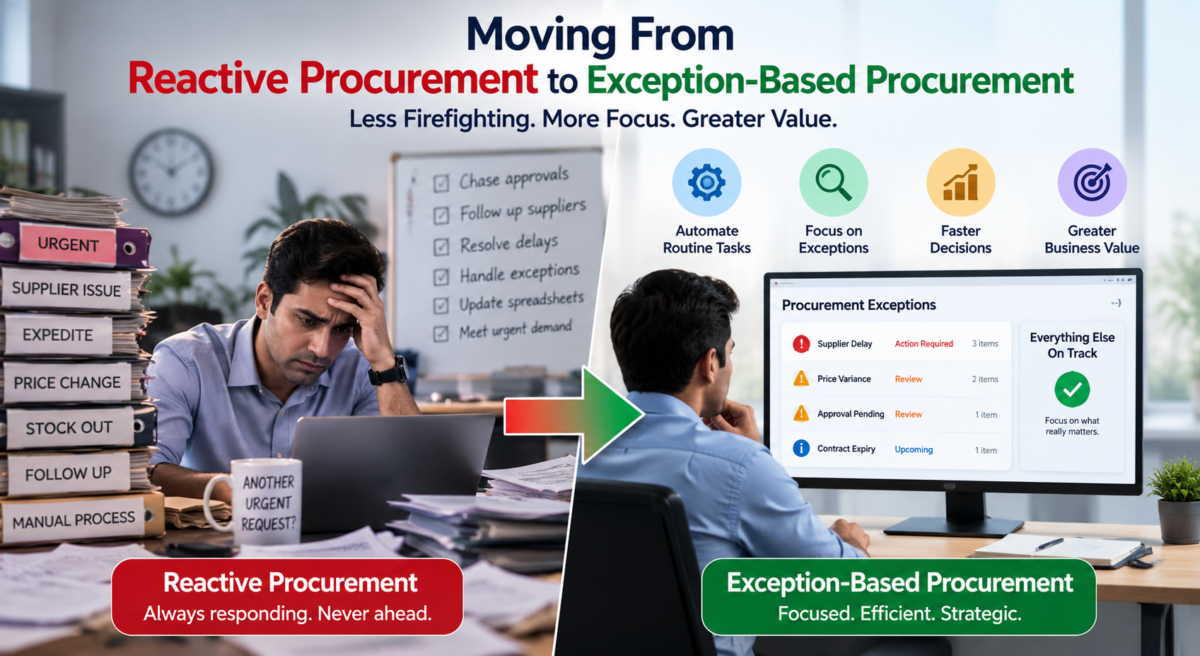
Procurement teams often have access to many systems.
Most mid-sized and large companies already use ERP systems, approval workflows, email, reports, spreadsheets, and supplier records. But buyers still spend a lot of time asking simple questions about the status of things.
Has the supplier received the purchase order?
Has the shipment been sent?
Was the ASN (Advance Shipping Notice) shared before the shipment?
Why is the GRN (Goods Receipt Note) not complete?
Why is the invoice not processed?
Has finance responded to the supplier’s payment request?
This is the reality of reactive procurement.
The issue isn’t that procurement teams don’t work hard. The problem is that their attention gets spread thin across too many transactions, too many suppliers, and too many disconnected updates. When every task requires manual checking, procurement becomes a job of following up instead of taking control.
The next stage of procurement maturity is called exception-based procurement.
Exception-based procurement changes the way questions are asked. It moves from “What is the status of everything?” to “Which transactions need action now? Who is responsible for them? And what happens if they’re not resolved?”
For CIOs, CPOs, procurement leaders, and manufacturing executives, this shift is no longer optional. Supplier networks are getting bigger, timelines are tighter, and procurement teams are expected to support resilience, compliance, cost control, and visibility in execution.
About the Shift
Exception-based procurement is an operating model where procurement teams focus on transactions, suppliers, approvals, and workflows that fall outside expected rules or timelines.
Instead of manually checking every purchase order, invoice, shipment, and supplier query, teams act based on exception signals.
Examples of exceptions include:
- A purchase order not acknowledged on time
- A supplier changing the delivery date without notice
- An ASN not submitted before the shipment leaves
- A GRN that does not match the delivered goods
- An invoice stopped because of a mismatch with the purchase order or receipt
- A payment query that has been unanswered for too long
- A document or approval waiting for someone to take action
- A repeat issue with a supplier affecting delivery, quality, or communication
This model does not eliminate the need for judgment in procurement. It helps focus that judgment where it is most needed.
The best procurement teams are not the ones that chase every status update faster. They are the ones that identify risks early, assign clear ownership, and fix supplier issues before they affect the business.
Why This Matters
Reactive procurement adds hidden costs to the business.
A buyer checks with a supplier about the purchase order. The supplier calls about the invoice. Stores asks procurement about a delivery issue. Finance waits for an update on the GRN. Management requests a manual report. The supplier sends the same document again because it was missed in the first email.
Individually, these actions do not seem big. Together, they take up time, slow down decisions, and reduce trust between procurement, suppliers, finance, stores, and operations.
For manufacturing and engineering teams, the impact goes beyond procurement:
- Production teams lose confidence in delivery promises.
- Finance spends more time dealing with invoice issues.
- Suppliers face uncertainty about approvals and payments.
- Procurement teams are constantly under pressure to follow up.
- Leadership gets delayed information about supplier risks.
Exception-based procurement is important because it gives the company a more disciplined way to manage attention.
Not every transaction requires the same level of human effort. But every exception needs ownership, visibility, and resolution.
Key Highlights
- Procurement should move from chasing status updates to controlling exceptions. Buyers do not need to manually check every transaction. They should focus on supplier actions, delivery problems, invoice holds, and approval delays that need urgent attention.
- Supplier collaboration data is becoming an operational asset. PO acknowledgments, ASN submissions, GRN completions, invoice statuses, payment queries, and supplier communications create signals that can help spot risks earlier.
- ERP systems are still essential, but they are not always enough for supplier-facing tasks. ERP keeps a record of transactions. Supplier collaboration workflows help capture responses, exceptions, documents, and status updates related to those transactions.
- Exception visibility needs to include ownership. An alert without a clear responsible person is just noise. Exception-based procurement works when the next action is visible.
- AI in procurement relies on structured workflow data. Predictive insights require reliable signals from supplier behavior, transaction history, approvals, and exception patterns.
Industry Context
For years, procurement has worked on making processes like approvals, purchase orders, invoices, and reporting digital. However, many companies still rely on email and manual checks when dealing with suppliers. This creates a difference between what the system shows and what actually happens in the real world.
For example, a purchase order might be in the ERP system, but the supplier may still respond by email. A delivery might be expected, but the ASN may be missing. A goods receipt may be completed, but the invoice might be blocked because different teams—such as procurement, finance, stores, and the supplier—are not looking at the same issues.
This gap is more noticeable in companies that:
- Have many suppliers
- Have multiple plants or business units
- Use SAP or another ERP system for procurement
- Handle a large number of purchase orders
- Rely on vendors to manage delivery schedules
- Face pressure to follow up on invoices and payments
- Have high expectations for supplier performance and compliance
The way people talk about procurement technology is changing. In the past, the big question was, “How can we automate procurement tasks?” Now, the question is, “How can we build a procurement system that finds risks, guides actions, and improves supplier accountability?”
Exception-based procurement answers this question better than automation alone.
Where Reactive Procurement Fails
Reactive procurement does not work well when there are too many follow-ups for the team to handle consistently.
Some signs are clear.
1. Buyers Turn Into Status Coordinators
Buyers end up spending time asking suppliers for updates instead of managing sourcing, supplier performance, and pricing decisions.
This is not about the buyers’ skills. It is about not having reliable visibility on the supplier side.
2. Suppliers Rely Too Much on Procurement for Updates
When suppliers cannot see the status of purchase orders, delivery schedules, invoices, or payment progress, they contact procurement repeatedly.
This increases the workload for both sides and worsens the supplier experience.
3. Exceptions Are Found Too Late
A missing ASN might only be noticed when stores expect the goods. A goods receipt mismatch might only be found when an invoice is blocked. A delayed supplier response might be noticed when production is already waiting.
Exception-based procurement helps bring these issues to light earlier.
4. Leaders See Delayed Reports Instead of Real-Time Signals
Many procurement dashboards show what has already happened. Fewer show what needs to be done now.
Leaders need real-time visibility into unresolved issues by supplier, buyer, plant, approval stage, time since the issue began, and business impact.
Manual Procurement vs Exception-Based Procurement
| Reactive Procurement | Exception-Based Procurement |
| Buyers manually check the status of transactions | Teams focus on delayed or unhandled actions |
| Supplier updates are in emails and calls | Supplier responses are part of structured workflows |
| Issues are raised only after delays | Exceptions are visible early |
| Reports show past problems | Dashboards show actions that need to be taken |
| Suppliers depend on buyers for information | Suppliers get self-service visibility |
| Invoice and payment queries cause repeated follow-ups | Finance, procurement, and suppliers use clear status views |
| Procurement effort is spread across all transactions | Procurement focuses on high-impact exceptions |
The difference is not just about speed. It is about better decision-making.
When teams know which exception is important, who is responsible, and how long it has been unresolved, procurement becomes more controlled and less reactive.
Expert Perspective
[Insert leadership quote here]
A good executive quote for this article would be:
“Procurement transformation should not be measured only by how many workflows are automated. It should be measured by how quickly teams can find supplier issues, assign responsibility, and stop avoidable problems.”
Strategic Playbook: How Leaders Can Move Toward Exception-Based Procurement
1. Start With the Highest-Volume Follow-Ups
Do not try to change all procurement workflows at once.
Start where the team is already doing a lot of manual work:
- Follow-ups for PO acknowledgments
- Updates on delivery status
- Missing ASN submissions
- GRN mismatches
- Invoice holds
- Payment inquiries
- Vendor document approvals
These areas often show the most operational problems.
2. Define What Counts as an Exception
Procurement, finance, stores, quality, IT, and suppliers may all define exceptions differently.
Leaders should start with simple rules:
- A PO not acknowledged within a specific time
- An ASN missing before the expected delivery
- A GRN pending beyond the receiving deadline
- An invoice blocked due to a mismatch
- A payment query that has not been answered on time
- A supplier document that has not been approved
- Repeated delivery or communication problems
Without clear rules, dashboards get cluttered and teams end up making decisions manually.
3. Connect Supplier Actions to ERP Records
ERP should stay as the main system that holds all official records.
The process that suppliers interact with should track all the steps related to ERP records, such as acknowledging, confirming, submitting an ASN, uploading an invoice, responding to queries, submitting documents, and keeping track of the status.
This creates a good model: ERP is used for controlling transactions, while supplier collaboration workflows help with tracking progress.
4. Make Ownership Visible
Every problem or exception should answer three key questions:
- Who is responsible for the next action?
- How long has the action been waiting?
- What process or business result is affected?
If ownership is not clear, the problem will keep moving through emails and meetings.
5. Give Suppliers Controlled Visibility
Suppliers do not need access to all the information. But they do need access to what is important.
Controlled visibility for suppliers can help reduce repeated questions about PO status, ASN, invoice submission, GRN progress, and payment tracking.
This improves the supplier experience and reduces the work for the buyer team.
6. Review Exception Trends, Not Only Open Items
A single exception might just be a one-time issue, but repeated exceptions can show bigger problems.
Monthly reviews should look at:
- Suppliers who often delay PO acknowledgments
- Plants that have frequent receipt issues
- Buyers with a lot of pending approvals
- Invoice categories that frequently get held up
- Supplier questions that take too long to respond to
- Processes where ownership is not clear
This is where exception management becomes part of managing supplier performance.
The AI Angle: Prediction Needs Process Discipline
AI in procurement will not be useful if supplier data is missing, spread out, or inconsistent.
Before procurement teams can predict risk, they need to capture supplier behavior through proper workflows.
Important signals include:
- Delays in PO acknowledgments
- Repeated ASN gaps
- History of GRN mismatches
- Frequency of invoice exceptions
- Aging supplier queries
- Changes in delivery commitments
- Delays in document and compliance actions
Once these signals are organized, AI can help with better prioritization, risk scoring, and predicting exceptions.
But the base is not AI first. The base is having clean, structured workflow data.
About Vendora SCM Software
Vendora SCM Software is a platform for managing vendors and collaborating with suppliers in manufacturing, engineering, and procurement-focused companies.
The platform helps with vendor onboarding, RFQs, purchase order sharing, delivery planning, ASN, GRN, invoice tracking, payment visibility, communications, reports, analytics, and supplier workflows connected to SAP or ERP systems.
Vendora is built for large companies that need better supplier collaboration, procurement visibility, workflow control, and vendor lifecycle management.
![A modern smartphone showing the [Vendor Portal Management System] dashboard for on-the-go vendor collaboration.](https://www.vendorascmsoftware.com/wp-content/themes/vendora/images/phone.webp)
