

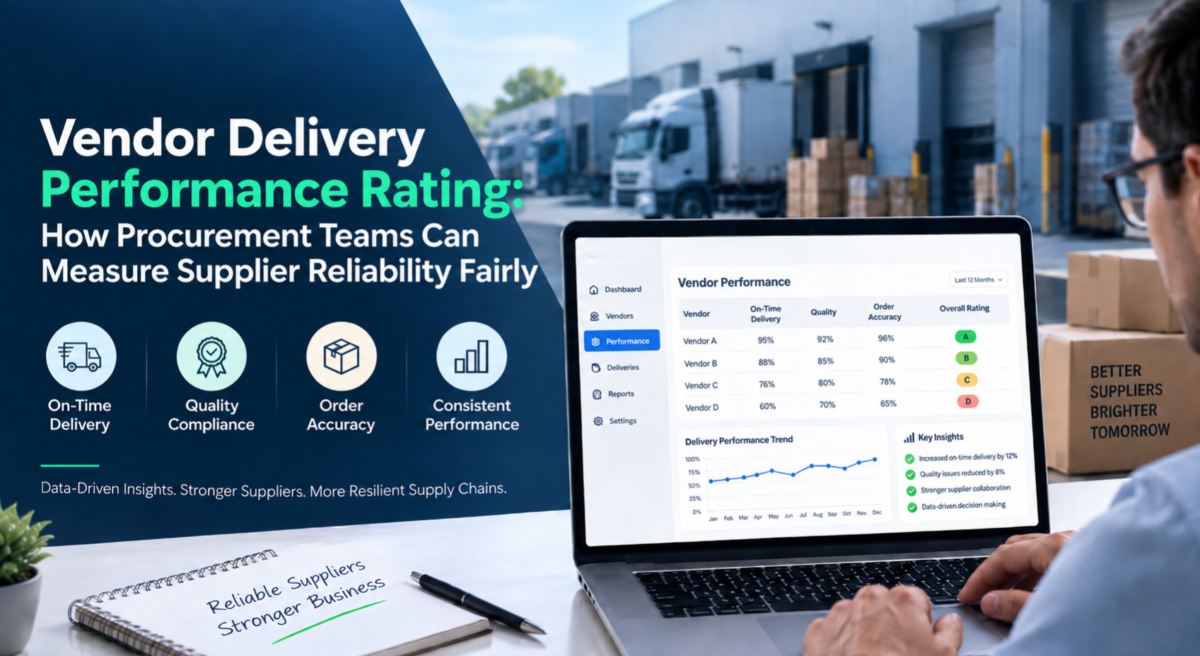
Delivery problems are often the first thing buyers notice from a vendor.
A vendor might offer good prices, respond quickly during the sourcing process, and agree to delivery terms when confirming a purchase order. But if goods arrive late, come in smaller quantities, or keep missing promised dates, it can affect production, storage, finance, customer deliveries, and management reports.
This is why it is important to track a vendor’s delivery performance.
For manufacturing and procurement teams, delivery performance should not be judged based on memory, isolated complaints, or one late shipment. It should be measured using consistent data, clear rules, and historical records.
A vendor delivery performance rating helps procurement teams compare suppliers more fairly, find ongoing delivery problems, and support better conversations about improving vendor performance.
What Is a Vendor Delivery Performance Rating?
A vendor delivery performance rating is a way to measure how reliably a vendor meets its delivery promises.
It usually checks whether the vendor delivered on time, provided the right quantity of goods, followed the terms in the purchase order, responded to delivery changes, and helped the buyer when problems or delays happened.
In simple terms, it answers one key question for procurement:
Can this vendor be trusted to deliver as promised?
A delivery rating may be part of a larger vendor evaluation or supplier scorecard. But it specifically looks at delivery behavior, which makes it useful for procurement, supply chain, stores, production planning, and management teams.
A good delivery performance rating helps teams understand:
- Whether the supplier delivers on time
- Whether delivery delays happen sometimes or often
- Whether the quantity promised matches what was actually received
- Whether the vendor alerts the buyer about delays early
- Whether delivery issues affect production or customer commitments
- Whether steps need to be taken to fix problems
- Whether the vendor should be preferred, watched closely, or improved
Without a structured approach, evaluating delivery can become subjective.
One buyer may base their rating on their most recent experience. Another might look only at cost. A production team might remember only the worst delay.
A structured rating system helps reduce these inconsistencies.
Why Delivery Performance Is a Clear Sign of Vendor Problems
Delivery failures are visible because they affect daily operations.
A late shipment can stop production planning. A partial delivery can cause urgent rescheduling. A missed delivery date can lead to calls between procurement, stores, logistics, and the vendor. If the same issue keeps happening, managing the vendor relationship becomes harder.
Common delivery issues include:
- Vendors accepting purchase orders but missing promised dates
- Partial deliveries without warning
- Frequent changes to delivery schedules
- Poor responses to follow-ups about delivery
- Incorrect delivery documents
- Materials arriving after production deadlines
- No visibility into shipment status
- Repeated differences between promised and actual deliveries
For procurement teams, these issues go beyond administrative work.
They affect production, internal trust, vendor negotiations, and decisions on which suppliers to choose.
A vendor delivery performance rating helps teams turn these delivery experiences into measurable data.
Common Challenges in Evaluating Vendor Delivery
Most companies already know which suppliers are unreliable.
The problem is that they often cannot prove it with consistent data.
1. Delivery Feedback Is Spread Out
Feedback about delivery may come from different teams, such as procurement, stores, production, quality, or logistics.
If this feedback is shared through emails, phone calls, or casual chats, it is hard to create a reliable record about the vendor.
2. Buyers Rely on Memory
In many procurement reviews, teams evaluate vendors based on recent experiences.
A vendor that had a delay last week might be rated poorly, while older repeated issues might be forgotten.
A rating system helps assess vendors over a set time period instead of depending only on recent memory.
3. All Delays Are Treated the Same
Not all delays affect the business in the same way.
A one-day delay with notice might be manageable. A repeated delay in a critical material might have a much bigger impact. A fair delivery rating should let procurement teams consider how often the delay happens, how serious it is, and how much impact it has.
4. Vendor Comparison Becomes Subjective
Without a clear scoring system, two vendors might be compared unfairly.
One vendor might be responsible for delivering many complex items, while another only handles simple, low-risk goods.
One vendor might inform the buyer early if there is a delay, while another might not say anything until the buyer asks.
Delivery rating systems make it easier to compare how well vendors are doing.
5. Corrective Actions Are Not Linked to Ratings
Delivery ratings should do more than just give a score.
They should help teams figure out what to do next.
If a vendor keeps underperforming, procurement might need to take steps such as a performance review, a meeting about service level agreements, or a plan to improve the vendor’s performance.
Why Traditional Methods Fail
Traditional ways of evaluating delivery often use spreadsheets, emails, ERP exports, and manual check-ins.
These methods might work when there are only a few vendors. But they get harder when a company deals with many suppliers, multiple plants, many purchase orders, and different delivery expectations.
Manual Approach vs Structured Rating Approach
| Manual Approach | Structured Rating Approach |
| Delivery problems are tracked through emails and phone calls. | Delivery data is collected using a set process. |
| Vendor ratings depend on what people think. | Vendors are judged based on the same standards every time. |
| It is hard to look back at delivery history. | Performance can be tracked over time. |
| Corrective actions are handled separately. | Poor ratings can lead to improvement steps. |
| Management only sees delayed orders. | Management can compare delivery performance across vendors. |
| Procurement struggles during talks with suppliers. | Buyers can use delivery data during supplier discussions. |
Manual methods do not connect delivery experience with vendor ratings.
A buyer might know a vendor is often late, but without clear data, the conversation becomes based on opinion. Vendors can question the feedback. Management might ask for proof. Procurement might struggle to justify why they chose a vendor.
A structured delivery performance rating solves this by creating a clearer and more consistent way to evaluate vendors.
How Modern Vendor Performance Solutions Solve These Problems
Modern vendor management systems help procurement teams evaluate delivery performance more consistently.
The goal is not only to give a score. The real value is creating a repeatable review process that leads to better decisions.
Structured Vendor Evaluation
A Vendor Performance Evaluation page lets users start an evaluation, choose a vendor, enter performance details about delivery, and submit the evaluation.
This gives procurement teams a clear process instead of relying on informal feedback.
Consistent Delivery Inputs
Delivery-related inputs can include on-time delivery, delivery completion, how the vendor responds to delays, how well they meet agreed-upon dates, and how they handle issues.
Using the same criteria each time lets procurement teams compare vendors more fairly.
Better Vendor Comparison
A structured rating helps buyers compare vendors over time.
For example, two vendors might both have delays, but one might alert the buyer early and recover quickly, while another might delay repeatedly without updates.
A delivery rating can show these differences.
Support for Corrective Action
Poor delivery performance should lead to action.
A structured rating can support reviews, improvement plans, escalation, or corrective action discussions.
This helps procurement move from dealing with complaints to managing vendors for improvement.
Historical Tracking
Tracking past delivery ratings improves supplier discussions and negotiations.
When procurement teams can look at past delivery trends, they can have more objective conversations about service, pricing, allocation, and future sourcing.
How Vendor Delivery Performance Rating Supports Better Procurement Decisions
A strong delivery rating process helps procurement teams make better decisions in four areas.
1. Vendor Selection
Past delivery performance should influence future choices.
A vendor with lower prices but a history of delivery failures may not be the best choice for critical or time-sensitive needs.
2. Vendor Negotiation
Delivery history builds buyer confidence during negotiations.
If a vendor asks for better rates or more allocation, procurement can check whether their delivery reliability supports the request.
3. Vendor Improvement
A rating system helps vendors understand where they need to improve.
Instead of just saying, “Your delivery is bad,” the buyer can explain specific issues: delayed dispatch, missed deadlines, incomplete deliveries, poor communication, or repeated changes.
4. Management Reporting
Leaders often want to know which vendors are reliable and which pose risks.
A delivery rating gives management a structured view of supplier reliability instead of only looking at complaints.
Best Practices for Implementing Vendor Delivery Performance Rating
1. Define Delivery Criteria Clearly
Before starting, be clear about what delivery performance means for your business.
Common criteria include:
- Delivering on time
- Delivering the exact quantity promised
- Delivering by the date on the purchase order
- Responding to changes in delivery plans
- Informing buyers about delays
- Tracking repeated delivery problems
- Ensuring delivery documents are accurate
- Offering support during urgent needs
Avoid using vague terms like “good delivery” or “bad service” because they can be confusing and lead to inconsistent ratings.
2. Use the Same Rating Method for All Vendors
If different buyers rate vendors differently, the ratings will not be fair or useful.
Create a common way to rate vendors so they can be compared fairly over time, across departments, and in different locations.
3. Separate Delivery Performance From Price
A vendor that is cheaper may not always be the best choice.
Delivery should be measured on its own so the team can clearly see the trade-off between cost and reliability.
4. Check Ratings Regularly
Delivery ratings should not be done just once.
Checking them monthly, quarterly, or for specific projects helps find problems early before they cause bigger issues.
5. Link Ratings to Actions
If a vendor keeps having delivery issues, the rating should lead to a clear plan.
This could include a meeting to review the vendor, asking them to improve, setting up a plan for better performance, discussing service level agreements, or watching their performance more closely.
6. Keep Track of Past Ratings
Keeping records helps teams understand how a vendor is performing over time.
It shows whether the vendor is getting better, getting worse, or staying the same.
7. Use Delivery Data When Choosing Vendors
Past delivery performance should be considered when deciding which vendor to work with for new orders or contracts.
This includes looking at price, quality, ability to deliver, and other business terms.
Practical Example: Delivery Rating in a Manufacturing Procurement Team
Imagine a manufacturing company that buys materials from different suppliers.
Vendor A offers good prices but often delays deliveries by three to five days.
Vendor B is a bit more expensive but always meets delivery dates and tells the buyer early if there are any delays.
Vendor C meets standard delivery dates but struggles with urgent orders.
Without a structured rating system, the procurement team might only look at price or recent experience when choosing a vendor.
With a delivery performance rating, the team can look at:
- History of on-time deliveries
- How well the vendor meets the promised quantity
- How the vendor handles delivery delays
- How often the vendor has delivery problems
- How much these issues affect production plans
- Whether the vendor has improved after past feedback
This makes comparing suppliers more helpful.
Procurement can decide which vendors are best for critical orders, which ones need improvement, and which ones should get more business.
What Vendora Adds to Vendor Delivery Evaluation
Vendora’s Vendor Performance Evaluation page helps teams evaluate vendors in a structured way.
It allows users to start evaluations, pick vendors, enter delivery-related performance data, and send the evaluations for review.
This creates a consistent way to measure delivery performance across all vendors and over time.
The benefit is not just in giving a rating. It is about making delivery performance visible, comparable, and useful for helping vendors improve.
Vendora supports procurement teams by:
- Letting them evaluate vendors using structured performance data
- Helping compare delivery performance between vendors
- Keeping track of delivery ratings over time
- Supporting discussions about how to improve vendor performance
- Increasing visibility for procurement and management teams
- Using delivery performance as part of vendor reviews and negotiations
This is especially useful for companies that want vendor discussions to be based on real past evaluations instead of random feedback.
![A modern smartphone showing the [Vendor Portal Management System] dashboard for on-the-go vendor collaboration.](https://www.vendorascmsoftware.com/wp-content/themes/vendora/images/phone.webp)
