

Executive Summary
Organizations have invested heavily in procurement technologies over the past decade, yet many continue to struggle with delayed approvals, fragmented supplier communication, and limited visibility across the procure-to-pay lifecycle. The assumption that technology alone drives transformation is flawed.
The real challenge is decision architecture—the way procurement decisions are structured, governed, and executed. Technology can automate workflows, but it cannot compensate for unclear ownership, inconsistent approvals, or disconnected decision-making.
This article introduces the Procurement Decision Architecture Framework (PDA Framework), a strategic model that helps procurement leaders redesign how decisions are made before investing in additional technology.
Technology accelerates procurement. Decision architecture determines whether it accelerates the right decisions.
Introduction
Procurement leaders are under increasing pressure to deliver cost savings, strengthen supplier relationships, improve compliance, and build resilient supply chains. In response, many organizations invest in automation platforms, AI-powered analytics, and digital procurement solutions expecting transformational outcomes.
Yet the results often fall short.
Purchase requests still stall. Vendor approvals remain inconsistent. Finance teams chase missing documentation. Buyers continue relying on emails and spreadsheets despite sophisticated procurement software.
The issue isn’t a lack of technology.
It’s that procurement organizations have optimized workflows without redesigning the decisions that drive them.
Organizations that outperform their peers don’t necessarily have more advanced technology—they have better decision systems.
Technology Solves Process Problems. Decision Architecture Solves Business Problems.
Automation excels at executing repeatable tasks.
It can generate purchase orders, route approvals, match invoices, and notify stakeholders. However, automation becomes ineffective when the underlying decision process is inconsistent.
Common symptoms include:
- Multiple approval paths for similar purchases
- Unclear ownership between procurement, finance, and operations
- Manual exceptions becoming the norm
- Vendor evaluations based on inconsistent criteria
- Limited visibility into approval bottlenecks
Industry best practices consistently emphasize that digital transformation requires process redesign alongside technology adoption. Organizations such as Google Search Central, Gartner, and the Nielsen Norman Group similarly advocate aligning technology with business processes rather than digitizing inefficient ones.
Technology magnifies existing operating models—for better or worse.
Why Procurement Complexity Is Increasing
Industrial procurement has evolved significantly.
Manufacturing, automotive, aerospace, engineering services, and defense organizations now manage:
- Global supplier ecosystems
- Multi-level approval hierarchies
- Compliance-driven purchasing
- Complex contractual obligations
- Cross-functional purchasing decisions
As complexity grows, every procurement decision becomes interconnected.
A delayed vendor evaluation affects purchase orders.
Delayed purchase orders impact production.
Production delays influence customer commitments.
The challenge is no longer processing transactions faster.
It’s enabling better decisions across the entire procurement lifecycle.
Every procurement delay is ultimately a delayed decision—not merely a delayed workflow.
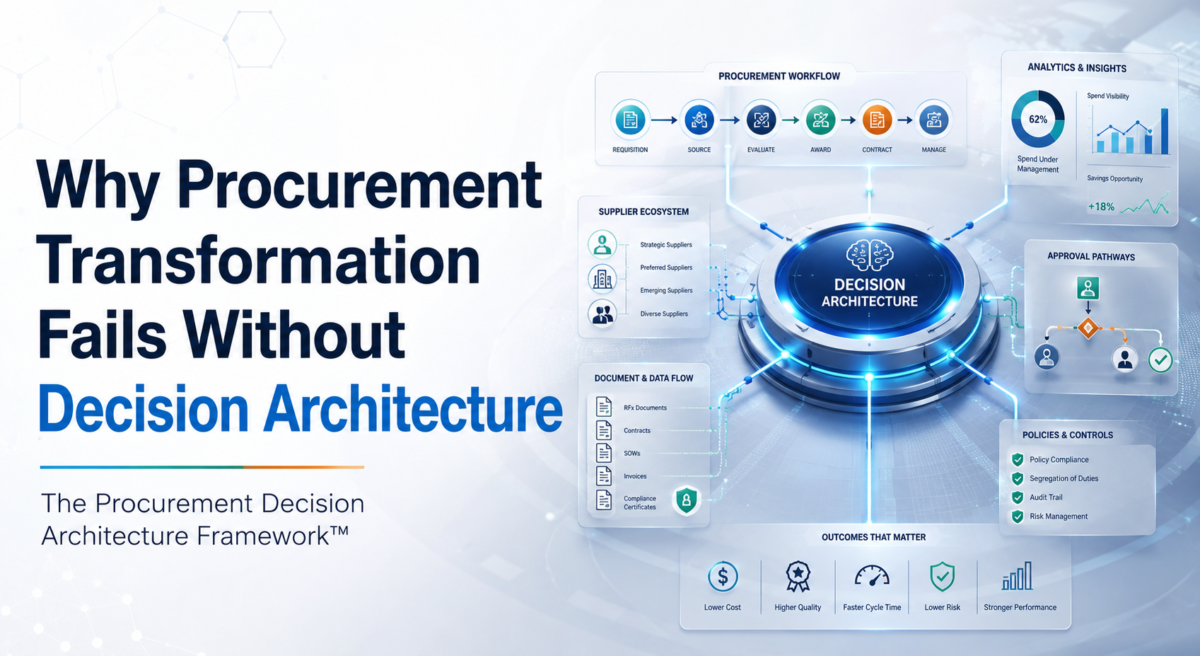
The Procurement Decision Architecture Framework™
Instead of asking, “Which procurement software should we buy?”, leaders should ask:
“How should procurement decisions flow across the organization?”
The Procurement Decision Architecture Framework provides five dimensions for evaluating procurement maturity.
| Pillar | Strategic Question |
|---|---|
| Decision Rights | Is ownership clearly defined for every procurement decision? |
| Decision Intelligence | Do stakeholders have accurate, real-time information? |
| Decision Velocity | Can routine decisions move quickly while preserving governance? |
| Decision Accountability | Is every approval and exception traceable? |
| Decision Learning | Does procurement continuously improve from historical data? |
Organizations that score highly across these dimensions typically experience greater procurement visibility, stronger supplier collaboration, faster approvals, and improved compliance—not because they automate more, but because they govern decisions more effectively.
Decision Visibility Is the New Competitive Advantage
Many procurement teams measure operational efficiency using cycle times or cost savings.
These metrics remain important, but they rarely explain why delays occur.
Decision visibility provides that missing context.
When leaders can identify:
- Where approvals slow down
- Why exceptions occur
- Which suppliers create recurring issues
- How purchasing decisions impact downstream operations
They move from reactive management to proactive governance.
This shift transforms procurement from an administrative function into a strategic business capability.
Practical Recommendations for Procurement Leaders
Organizations looking to strengthen procurement performance should begin with governance before automation.
Map Decision Ownership
Document who owns every approval, exception, escalation, and supplier decision.
Standardize Approval Logic
Reduce unnecessary variations across departments while preserving flexibility where business needs differ.
Improve Decision Visibility
Provide procurement, finance, and operations with a shared view of purchase requests, purchase orders, goods receipts, invoices, and approvals.
Automate Repeatable Decisions—not Judgment
Technology should remove administrative effort while leaving strategic supplier and sourcing decisions to experienced professionals.
Review Decision Metrics Regularly
Measure approval bottlenecks, exception frequency, supplier responsiveness, and procurement cycle times to continuously refine decision quality.
Common Mistakes
Many procurement transformation initiatives underperform because organizations focus on technology before governance.
Common mistakes include:
- Automating inefficient approval processes
- Measuring software adoption instead of decision quality
- Treating procurement as an isolated department
- Over-customizing workflows without standardizing governance
- Assuming AI can replace procurement expertise
Technology should reinforce sound procurement practices—not compensate for their absence.
Future Outlook
Artificial intelligence will undoubtedly reshape procurement.
AI will recommend suppliers, predict risks, automate documentation, and support sourcing decisions.
However, AI depends on structured decision environments.
Organizations with fragmented governance will struggle to extract meaningful value from advanced analytics because inconsistent decision processes produce inconsistent data.
The next generation of procurement leaders will distinguish themselves not by adopting the most AI tools, but by building decision architectures that allow AI to operate effectively, transparently, and responsibly.
Key Takeaways
- Procurement challenges often stem from poor decision architecture rather than inadequate technology.
- Automation delivers value only when supported by clear governance and standardized decision processes.
- Decision visibility enables faster approvals, better supplier collaboration, and stronger compliance.
- The Procurement Decision Architecture Framework helps leaders evaluate procurement maturity beyond software capabilities.
- Organizations that redesign decision-making before digitizing workflows are better positioned to achieve sustainable procurement transformation.
Conclusion:
For years, procurement transformation has centered on selecting the right platform, deploying automation, and adopting emerging technologies. While these investments remain important, they address only part of the challenge.
Competitive advantage increasingly depends on how effectively organizations design the decisions that technology supports.
When decision rights are clear, information is transparent, accountability is embedded, and continuous improvement becomes routine, procurement evolves from a transactional function into a strategic business capability.
Technology may power digital procurement, but decision architecture determines whether that power creates lasting business value. Organizations that recognize this distinction will be better equipped to build resilient supply chains, strengthen supplier relationships, and make faster, more confident procurement decisions in an increasingly complex operating environment.
![A modern smartphone showing the [Vendor Portal Management System] dashboard for on-the-go vendor collaboration.](https://www.vendorascmsoftware.com/wp-content/themes/vendora/images/phone.webp)
