

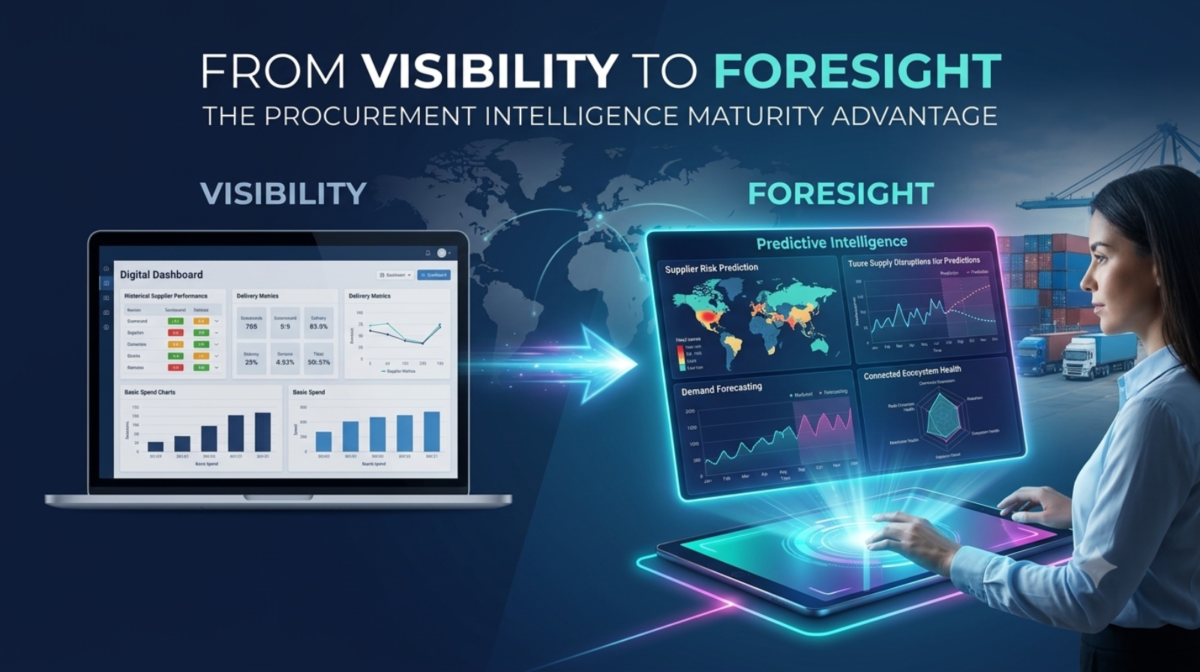
The Visibility Trap
Many procurement leaders assume that better dashboards automatically lead to better decisions.In reality, visibility is inherently reactive.It helps organizations answer questions such as:- Where is the shipment?
- Which suppliers missed delivery targets?
- What spend occurred last quarter?
- Which purchase orders are delayed?
Introducing the Procurement Intelligence Maturity Model™
Based on emerging procurement transformation trends, leading organizations are progressing through four distinct stages of procurement intelligence.Stage 1 — Visibility
Organizations gain transparency across spend, suppliers, purchase orders, and operational workflows.Primary focus:- Reporting
- Dashboards
- Operational monitoring
Stage 2 — Insight
Organizations connect supplier, procurement, and operational data to identify trends and performance drivers.Primary focus:- Procurement analytics
- Supplier performance management
- Spend intelligence
Stage 3 — Foresight
Organizations use predictive analytics and AI to anticipate disruptions, supplier risks, and sourcing challenges.Primary focus:- Supplier risk management
- Predictive procurement
- Demand forecasting
Stage 4 — Autonomous Intelligence
AI continuously monitors supplier ecosystems, recommends actions, and supports procurement decision-making in real time.Primary focus:- Procurement AI
- Autonomous sourcing
- Intelligent supplier networks
Why Foresight Matters More Than Ever
Consider a common manufacturing scenario.A Tier-1 supplier continues to meet delivery commitments. Traditional supplier scorecards indicate strong performance.However, external indicators reveal growing financial pressure, declining workforce availability, and logistics instability in the supplier’s region.A visibility-focused organization sees no issue.A foresight-driven organization identifies the risk months earlier and develops alternative sourcing strategies before disruption occurs.This distinction can determine whether a production line remains operational or experiences costly downtime.The Three Pillars of Procurement Foresight
1. Predictive Supplier Intelligence
Future-focused procurement organizations continuously evaluate supplier health rather than conducting periodic assessments.They analyze:- Delivery performance trends
- Capacity utilization
- Financial indicators
- Market conditions
- Supplier responsiveness
2. AI-Driven Procurement Analytics
Traditional procurement analytics explain historical performance.Procurement AI goes further by identifying hidden patterns and recommending actions.Examples include:- Predicting supplier delivery failures
- Forecasting material shortages
- Identifying sourcing alternatives
- Detecting emerging supplier risks
3. Connected Supplier Ecosystems
Procurement foresight depends on access to accurate supplier data.Organizations that integrate supplier collaboration, procurement operations, ERP systems, and supplier communication workflows create stronger intelligence foundations.Without connected data, predictive procurement remains difficult to achieve.Three Predictions for Procurement Leaders
The next five years will fundamentally reshape procurement operating models.Prediction #1
Supplier intelligence will become as important as spend intelligence.Prediction #2
Procurement AI will move from recommendation engines to decision-support systems.Prediction #3
Organizations will increasingly compete based on the quality of their supplier ecosystems rather than the efficiency of individual procurement processes.Executive Takeaway
The first generation of procurement transformation focused on digitization.The second focused on visibility.The next generation will focus on foresight.Procurement leaders who invest in predictive analytics, supplier intelligence, supplier risk management, and connected supplier ecosystems will be positioned to make faster decisions, reduce disruptions, and strengthen supply chain resilience.In the future, the most successful procurement organizations will not be those that see the most data.They will be those that can see what is coming next.FAQs;
What is procurement intelligence?
Procurement intelligence is the use of procurement analytics, supplier data, market intelligence, and AI to support strategic sourcing and procurement decision-making.
What is procurement foresight?
Procurement foresight refers to the ability to predict supplier risks, disruptions, and sourcing challenges using predictive analytics and AI-driven insights.
How does procurement AI improve supplier risk management?
Procurement AI continuously analyses supplier performance, external risk indicators, and operational data to identify potential disruptions before they impact business operations.
Content ownership: Vendora SCM Software Editorial Team
Subject-matter review: Procurement, Vendor Management & ERP Implementation Team
Last reviewed: 04 July 2026
Learn more about Vendora’s company background and implementation experience on the About Us page.
![A modern smartphone showing the [Vendor Portal Management System] dashboard for on-the-go vendor collaboration.](https://www.vendorascmsoftware.com/wp-content/themes/vendora/images/phone.webp)
